
Keeping Sheep in Australia: The Complete Guide
Sheep need a PIC whatever the number, and electronic ID tags are now mandatory in Western Australia and arrive across the east coast by 1 January 2027. Choose a breed to suit your climate (shedding breeds avoid shearing and have lower flystrike risk), keep at least two, and plan for flystrike and worms.
 Printable one-page guide
Set your climate zone and this page will show what to do with sheep where you live, what to watch for right now, and the rules for your state. It stays on this device. Find my climate zone
Wool, shedding or hair sheep?
The first decision is breed. Wool breeds (Merino, Corriedale, Romney) need shearing every year and are most prone to flystrike. Shedding breeds such as the Dorper and Wiltshire lose their fleece naturally, and WA DPIRD notes that hairy Dorpers and shedding Wiltshires have a lower flystrike risk than woolly Merinos. Lower is not none: shedding sheep still get worms and need checking. Our sheep guide covers the basics. Sheep are flock animals, so keep at least two.
Registration, tags and council rules
A PIC (property identification code) is a legal requirement for anyone who owns sheep, cattle or goats, whatever the number. Each time sheep leave or arrive you need a movement document (an NVD, or in Victoria the sheep and goat consignment declaration), and the receiver records the move in the NLIS database. Order NVDs and tags at least two weeks ahead (NSW advice). Electronic ID (eID) is being phased in:
| State | What to check | Rules tool |
|---|---|---|
| NSW | PIC required for any number. eID tag before leaving the property for animals born from 1 Jan 2025, and all sheep and farmed goats from 1 Jan 2027. Animals that never leave the property of birth are exempt | Council rules |
| Victoria | PIC required (free). eID tags for sheep and non-exempt goats; dairy and miniature goat breeds do not need electronic tags but still need a movement document and NLIS record | Council rules |
| Queensland | PIC required for any number. eID for animals born from 1 Jan 2025 and all animals from 1 Jan 2027 | Council rules |
| South Australia | PIC required. eID for animals born from 1 Jan 2025 and all from 1 Jan 2027, regardless of numbers or whether they are kept as pets | Council rules |
| Western Australia | PIC required. All sheep and goats must be eID tagged before leaving any property from 1 July 2026; receiver records the movement within 48 hours | Council rules |
| Tasmania | PIC required. eID for newborns from 1 Jan 2025 and all from 1 Jan 2027; applies to backyard owners | Council rules |
| Northern Territory | PIC required, with an NT waybill for movements; the national plan lists 1 Jan 2025 for eID (not re-checked) | Council rules |
| ACT | PIC required; the national plan lists 1 Jan 2025 for eID (not re-checked) | State rules |
Checked 7 October 2026. Rules are changing quickly, so confirm dates with your state agency. See our PIC glossary entry and state-by-state livestock rules.
Find your council’s livestock limits with My Council in One Place, and read the permits and fees article.
How many sheep per hectare?
The honest answer is: it depends on rainfall and pasture. One DSE (dry sheep equivalent) is the feed for a 45–50 kg dry sheep, and our Stocking Rate & Grazing Planner treats a ewe with lambs as 2 DSE. One forum example from 2012 (low confidence) had 50 ha at 600 mm supporting about 3.3 ewes a hectare. Native pasture might carry 1–5 DSE/ha and improved pasture 6–10, and Tasmanian data show spring pasture growth many times higher than summer, so carrying capacity swings with the season.
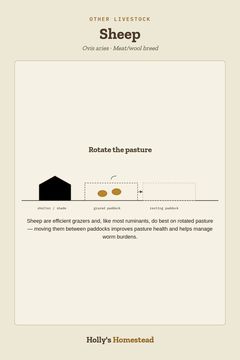
Hay-fed yard and pasture-fed paddock are different numbers. Our Sheep Paddock Planner shows about 20 m² per sheep as a hay-fed yard minimum, and about 1,900 m² each if they live off pasture at 8 DSE/ha and 1.5 DSE per breeding ewe (8 DSE/ha is a WA council rural-residential planning basis; NSW DPI gives about 10 DSE/ha for fertilised tableland pasture). Use the stocking planner and Livestock Feed & Hay Budgeter for your own paddock. Rotate paddocks: rotational grazing.
Flystrike, shearing and crutching
Blowflies need temperatures above 17°C (peak 26–36°C), and flystrike risk is greatest in warm, wet spring and autumn weather; wind over 30 km/h stops fly activity. AWI says shearing or crutching at or before fly season gives up to six weeks of protection from body and breech strike, or as little as three weeks if sheep are scouring. The maggot lifecycle is about 17 days. Check sheep at least every two days in fly season, tail and crutch long-wool sheep to reduce dags, quarantine new sheep and bury carcasses. If you find strike, clip 5 cm of clean wool around it and use a registered dressing. See flystrike and shearing.
Shearing costs and fleece value for a small flock are not verified: for a few sheep, shearing often costs more than the fleece is worth, and our calculator’s defaults (4 kg clean wool per ewe at $12/kg) are unchecked. If you want yarn, see from fleece to yarn and carding.
Worms and drench resistance
Drench resistance is widespread. A national survey (2009–12, 390 farms) found benzimidazole resistance on 44–57% of farms, levamisole on 30–41%, macrocyclic lactones on 10–26% and naphthalophos on 17–27%. WormBoss advises a DrenchTest every three years, a quarantine drench for introduced sheep, using combinations and managing grazing. In summer-rainfall and tropical areas barber’s pole worm is the main killer: Barbervax is registered for sheep, with three priming doses two to four weeks apart and boosters every four to six weeks in the risk season. See drenching.
Vaccines, minerals and copper
A 6-in-1 vaccine such as Cooper’s Guardian protects against pulpy kidney, black disease, blackleg, malignant oedema, tetanus and cheesy gland: two doses four to six weeks apart, then a yearly booster, with ewes ideally given theirs two to three weeks before lambing (check your product label). Selenium is low on sandy or granite soils and in clover pastures, and cobalt is low on coastal calcareous sands; white muscle disease affects lambs, so ask a vet about blood-testing weaners.
Copper: sheep are easily poisoned by it, especially British breeds and crosses, and suggested maximum dietary copper is 25 mg/kg. Check the label before feeding any goat, cattle or horse feed to sheep. Goats have the opposite problem, so do not apply one rule to both.
Weather matters too. BoM’s “sheep graziers warning” is triggered by combined cold, wind and rain, and recently shorn sheep and newborn lambs are most at risk. Above 40°C, minimise handling and provide shade and cool water; newly shorn sheep may drink over 80% more.
Home kill: NSW allows meat from an animal you kill at home to be eaten by you and visiting family and friends, but not sold, traded or served to paying guests (NSW Food Authority). Queensland is stricter: only people living on the property may eat it, it cannot leave the property and cannot be traded (Safe Food Queensland). We have not verified the other states, so check with your state food regulator. Our home slaughter guide covers the process.
For the cuts, see butchering lamb and goat. Selling lamb generally means a registered processor: we have not verified state custom-kill rules.
Costs
Use the Sheep Cost & Payback Calculator, but check its defaults against your own prices: it assumes four ewes, 1.2 lambs per ewe and $22 a ewe a year for treatment. Add shearing, tags and vet costs. How much land do you need? gives the bigger picture.
How sheep change with your climate zone
Set your zone to see what applies to you.
Tropical
Wool breeds are unsuited to heat, flystrike and barber’s pole worm, so consider hair or shedding breeds. Barber’s pole is the main summer killer.
Subtropical
Summer rain brings barber’s pole worm and flystrike in warm, humid weather. Shedding breeds suit, and Barbervax is relevant.
Warm Temperate
Flystrike peaks in warm, wet spring and autumn: crutch before the season. Selenium and cobalt can be low on sandy, granite and coastal soils.
Mediterranean
Winter-rainfall scour worms, a summer feed gap and frequent cold-snap warnings in SW WA and southern SA. Manage hot-weather shearing.
Cool Temperate
Cold, wet, windy snaps threaten shorn sheep and new lambs. Provide shelter belts, watch footrot and (in Tasmania) liver fluke.
Arid
Carrying capacity is very low, so expect to hand-feed. Provide shade and plenty of water (5 L a day in our planner, more in heat); Dorpers are adapted to low rainfall.
Not sure of your zone? Use Find My Climate Zone.
Watch and learn
Video transcript
Intro: Holly's Homestead.
Title card: Sheep — difficulty: Easy–moderate.
Quick reference: Space: 2–3m² shelter, 400m²+ yard area per sheep if hay-fed (pasture-fed sheep need about 1,900m² each or more at 8 DSE/ha); Diet: Pasture-based, hay in poor conditions, minimal grain needed; Water: Constant fresh access; Temperament: Calm, flock-oriented, skittish if handled roughly; Lifespan: 10–12 years.
Housing & setup: Shelter: Simple shelter or shade — sheep are generally hardy and need less housing than pigs or goats.
Daily care: Rotate grazing paddocks to manage pasture and parasite load.
Health & problems: Worms — manage with pasture rotation and monitoring; resistance is a growing issue, so avoid over-reliance on drenching alone.
Production & harvest: Processing age: 4–12 months for meat breeds depending on target size.
Outro: free printable A4 guide at hollyshomestead.com.au.
Video transcript
Intro: Holly's Homestead.
Title card: Wool — From Fleece to Usable Yarn — difficulty: Moderate.
Quick reference: Difficulty: Moderate; Time: Many hours total; Cost: Low–moderate (tools); Best Season: After shearing; Frequency: Once or twice a year per animal.
What you'll need: Raw fleece from shearing
Method: 1. Skirt the fleece, removing heavily soiled, matted, or short edge sections that won't process well.
Troubleshooting: Wool felting during washing — water too hot or too much agitation; use warm water and handle gently, minimising movement.
Timing & maintenance: Best time: Process fleece reasonably soon after shearing, before it accumulates more contamination in storage.
Outro: free printable A4 guide at hollyshomestead.com.au.
Video transcript
Intro: Holly's Homestead.
Title card: Butchering Lamb & Goat — difficulty: Moderate–hard.
Quick reference: Difficulty: Moderate–hard; Time: 1–2 hrs; Cost: Low (knives) once set up; Best Season: Any time, cooler weather easier; Frequency: As animals reach processing age.
What you'll need: A sharp boning knife and a butcher's saw for bone
Method: 1. Hang or support the carcass securely for the initial breakdown.
Troubleshooting: Uneven or ragged cuts — usually knife technique or an insufficiently sharp blade; keep knives properly sharpened throughout the process.
Timing & maintenance: Best time: Any time, though a cool work environment (or cooler weather) makes the process considerably easier and safer.
Outro: free printable A4 guide at hollyshomestead.com.au.
Every guide, tool and rule page for sheep
Everything on this site that applies to sheep, in one place.
Animal guides
How-to guides
- Wool: From Fleece to Usable Yarn
- Milking Sheep & Goats
- Butchering Lamb & Goat
- Home Slaughter: Process & Regulations
- Heavy-Duty Livestock Fencing
- Rotational Grazing
- Windbreaks & Shelterbelts
Rules and costs
- Backyard livestock rules by state
- Best states for backyard livestock
- Council permits and livestock fees
- Queensland council livestock rules
- NSW council livestock rules
- Victoria council livestock rules
- South Australia council livestock rules
- Western Australia council livestock rules
- Tasmania council livestock rules
- NT council livestock rules
Related reading
Words worth knowing
Frequently Asked Questions
Do I need a PIC for a few sheep?
Yes. A PIC is required for anyone who owns sheep, cattle or goats, whatever the number.
Do sheep need electronic ID tags?
Yes in most states. Western Australia requires them for all sheep from 1 July 2026. NSW, Queensland, SA and Tasmania require them for sheep born from 1 January 2025 and for all sheep from 1 January 2027.
Which sheep do not need shearing?
Shedding breeds such as the Dorper and Wiltshire shed their fleece. They have a lower, not zero, flystrike risk and still need worm control.
How many sheep per hectare in Australia?
It depends on rainfall and pasture quality. Native pasture might carry 1–5 DSE/ha and improved pasture 6–10, with a ewe with lambs counting as about 2 DSE. Use our stocking planner for your paddock.
When is flystrike a risk?
When blowflies are active above 17°C, with the greatest risk in warm, wet spring and autumn weather. Shearing or crutching before the season gives up to six weeks of protection.
Can I feed goat feed to sheep?
Check the label first. Sheep are easily poisoned by copper, and the suggested maximum dietary level is 25 mg/kg.
Can I kill my own lamb?
In NSW you may eat home-killed meat with visiting family and friends but not sell it. Queensland allows only people living on the property to eat it. Check your state.
Sources: Integrity Systems: registering for a PIC · NSW DPI: sheep and goat eID explained · Business Queensland: sheep and goat identification · Agriculture Victoria: owning, keeping and moving sheep and goats · NRE Tasmania: sheep and goat eID · WA DPIRD: sheep and goat eID · Stock Journal: mandatory eID by 2027 · WA DPIRD: keep sheep parasites at bay · AWI: flystrike factsheet · WormBoss: national drench resistance · NRM South: carrying capacity · Coopers: Guardian 6-in-1 · Flock & Herd: chronic copper poisoning · Agriculture Victoria: selenium and B12 for sheep · SBS: sheep grazier warning explained · SA Landscape Board: grazing stocking rates · Shire of Donnybrook-Balingup: stocking rates policy · NSW Food Authority: home kill · Safe Food Queensland: home kill