
Keeping Pigs in Australia: The Complete Guide
You need a PIC even for one pet pig, and you cannot legally feed it any food that contains or has touched meat. Pigs must have shade and water, and Australia is on watch for African swine fever, so register, tag and know the emergency hotline: 1800 675 888.
 Printable one-page guide
Set your climate zone and this page will show what to do with pigs where you live, what to watch for right now, and the rules for your state. It stays on this device. Find my climate zone
Are pigs right for you?
Pigs are intelligent, strong, messy and escape artists, and they are subject to the same laws as commercial piggeries, even if you only keep one as a pet (RSPCA). Commercial breeds reach 250–300 kg. Miniature breeds such as the pot-bellied and Kune Kune cannot be imported, and Australian “miniatures” still grow to 50–90 kg with a shoulder height of up to 60 cm. Our pig guide covers the basics.
Registration, tags and council rules
A PIC is required for any land with one or more pigs (NSW DPIRD), and in Queensland you register as a biosecurity entity, which is free for non-commercial keepers and gives you a PIC. Pigs must carry an NLIS ear tag: a yellow breeder tag (left ear) if farm-bred, or an orange post-breeder tag (right ear) if purchased. A pig over 25 kg (30 kg in Queensland) can be tattooed or branded instead. Tags cannot be removed until the abattoir, and a PigPass (NVD) must accompany any move and be kept for three years. The receiver records the move within two working days.
| State | What to check | Rules tool |
|---|---|---|
| NSW | PIC required for any land with one or more pigs; NLIS ear tag and PigPass/NVD for moves; home kill allowed for personal use and visiting family and friends, no sale | Council rules |
| Victoria | PIC required; outdoor piggeries need a planning permit; prohibited pig feed rules apply (penalty of 120 penalty units for an individual); slaughter by a suitably qualified person | Council rules |
| Queensland | Biosecurity entity registration for one or more pigs (free for non-commercial; gives you a PIC); council approval varies (Livingstone Shire bans pigs on allotments under 4,000 m²); home kill meat must stay on the property and be eaten only by people living there | Council rules |
| South Australia | Prohibited pig feed rules apply with fines up to $10,000; PIC and NLIS identification apply (confirm with PIRSA) | Council rules |
| Western Australia | PIC required; council approval first; pigs over 10 weeks need identification within seven days of leaving; waybill required | Council rules |
| Tasmania | PIC required; planning approval for any operation; the Tasmanian backyard pig guide suggests at least 2 m² shelter per pig | Council rules |
| Northern Territory | Not verified here: check with NT DAF and your council | Council rules |
| ACT | Not verified here: check with the ACT Government and your council | State rules |
Checked 7 October 2026. We could not verify the NT and ACT, and confirm SA identification rules with PIRSA. See our state-by-state livestock rules.
Councils add their own rules: Livingstone Shire (Qld) bans pigs on allotments under 4,000 m² and requires a 10 m setback from neighbouring homes. Find your own with My Council in One Place and read the permits and fees article.
What you can and cannot feed
Do not feed meat or anything that has touched meat. Prohibited pig feed (often called swill) is any food waste that contains or has been in contact with meat: pies, sausage rolls, bacon, deli meats, pizza and household table scraps. This applies to pet pigs, and the penalty in South Australia is a fine of up to $10,000. Allowed feeds include commercial pig rations, grain, fruit and vegetables, and bread that has not touched meat; state agencies also allow Australian milk and dairy, though Queensland lists eggs as prohibited and SA lists them as allowed, so check your state.
Scraps are fine, but only the right kinds. Our Pig Cost & Payback Calculator keeps a scraps offset (default 25%, capped at 30%) and now lists what you can and cannot feed: only fruit, vegetable, meat-free bread and dairy scraps should count towards it. Pasture alone is not enough: the Tasmanian guide says it is “not a sufficient diet for any pig”. Plan quantities with the Livestock Feed & Hay Budgeter, which uses 2.2 kg per pig a day.
Housing, fencing, shade and water
The Tasmanian backyard pig guide gives a minimum of 2 m² of shelter per pig, doubled for a sow with a litter, and fences at least 90 cm high. Our Pig Pen Planner uses 1.2 m² of shelter and 25 m² of yard per pig as bought-in-feed minimums, while our guide suggests a more generous 4–6 m² and 100 m². Use at least the Tasmanian shelter figure, and rotate paddocks before more than 60% of the ground cover is gone (Tasmanian guide). Electric wire helps; see fencing basics.
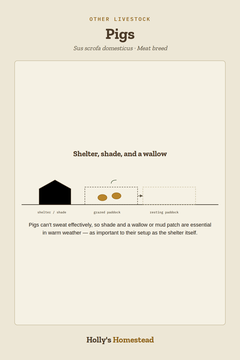
Victoria’s welfare standards require shade for outdoor pigs in hot weather, shelter in cold, constant water, and action to cool heat-distressed pigs; at 35°C or more use shade, ventilation and wallows. Water use is 10 L or more a day for a growing pig and about 30 L (45 L in warm weather) for a sow with a litter (Tasmania). White breeds sunburn more easily.
Health, breeding and disease watch
RSPCA advises desexing males and annual worming and hoof trimming. The Tasmanian guide suggests breeding gilts only at about 125 kg and eight months. See farrowing and weaning.
African swine fever (ASF) has never occurred in Australia but has reached Indonesia, Timor-Leste and PNG. It kills about 80% of infected pigs, and there is no registered vaccine. Report lameness, blisters on the snout or feet, incoordination, bloody diarrhoea, skin discolouration or sudden death to the Emergency Animal Disease Watch Hotline on 1800 675 888. Do not bring back undeclared pork products: infringement fines can reach $6,260. Foot-and-mouth disease is also a threat: check the current status with the Department of Agriculture. See biosecurity.
Home kill and butchering
Home kill: NSW allows meat from an animal you kill at home to be eaten by you and visiting family and friends, but not sold, traded or served to paying guests (NSW Food Authority). Queensland is stricter: only people living on the property may eat it, it cannot leave the property and cannot be traded (Safe Food Queensland). We have not verified the other states, so check with your state food regulator. Our home slaughter guide covers the process.
Victoria’s standards require slaughter by a suitably qualified person. Our guides cover butchering pork, curing and smoking, sausages and rendering lard. Cooler weather suits butchering. Our figure of 70–75 kg dressed and the calculator’s 65 kg differ, so use your breed’s numbers.
Costs
The Pig Cost & Payback Calculator defaults to $0.60/kg of feed, 275 kg of feed to market, 10 piglets per litter and $15/kg butcher prices; we could not verify these, so use your own. Remember tags, registration, fencing and council fees.
How pigs change with your climate zone
Set your zone to see what applies to you.
Tropical
Heat and humidity make shade and a wallow the main design driver, and the 35°C cooling trigger will be hit often. Choose coloured breeds, since pale pigs sunburn.
Subtropical
Heat, humidity and wet-season mud and parasites: provide shade, a wallow and well-drained pens. Register as a biosecurity entity in Queensland.
Warm Temperate
A moderate zone: provide shade for summer and dry, draught-free bedding for winter.
Mediterranean
Hot, dry summers raise heat and fire risk with straw bedding; winter brings mud.
Cool Temperate
Cold, wet winters need dry, draught-free bedding. The Tasmanian backyard pig guide applies directly.
Arid
Water supply is the constraint (10 L or more a day per growing pig), and pasture is negligible, so feed is bought in.
Not sure of your zone? Use Find My Climate Zone.
Watch and learn
Video transcript
Intro: Holly's Homestead.
Title card: Pigs — difficulty: Moderate.
Quick reference: Space: 4–6m² shelter, 100m²+ outdoor area per pig; Diet: Pig grower pellets + meat-free fruit and veg scraps (no meat or table scraps: illegal) + foraged pasture; Water: Constant fresh access, high intake; Temperament: Intelligent, food-motivated, can be strong-willed; Lifespan: 10–15 years if kept beyond meat age.
Housing & setup: Shelter: Solid, weatherproof shelter with deep straw bedding.
Daily care: Feed a consistent twice-daily ration plus any scraps.
Health & problems: Escaping — reinforce fencing regularly; electric wire is often the most reliable deterrent.
Production & harvest: Processing age: 5–7 months for standard meat breeds, longer for heritage/slow-growing breeds.
Outro: free printable A4 guide at hollyshomestead.com.au.
Video transcript
Intro: Holly's Homestead.
Title card: Butchering Pork — difficulty: Moderate–hard.
Quick reference: Difficulty: Moderate–hard; Time: 1.5–3 hrs; Cost: Low (knives) once set up; Best Season: Cooler weather strongly preferred; Frequency: As animals reach processing age.
What you'll need: A sharp boning knife and a butcher's saw for bone
Method: 1. Hang or support the carcass securely for initial breakdown.
Troubleshooting: Uncertain which cuts suit curing vs fresh use — belly and leg are the classic curing cuts (bacon and ham respectively); loin and shoulder work well fresh or for sausages.
Timing & maintenance: Best time: Cooler weather is strongly preferred given pork's relatively fast spoilage rate in warm conditions.
Outro: free printable A4 guide at hollyshomestead.com.au.
Video transcript
Intro: Holly's Homestead.
Title card: Making Sausages & Small Goods — difficulty: Moderate.
Quick reference: Difficulty: Moderate; Time: 2–4 hrs/batch; Cost: Moderate (equipment); Best Season: Cooler months preferred for fermented types; Frequency: Several batches per season.
What you'll need: A meat grinder and sausage stuffer (combined units are common)
Method: 1. Select and prepare meat and fat in the correct ratio for the sausage or small goods type.
Troubleshooting: Casings bursting while stuffing — overfilled or air pockets; fill at a moderate, even pace and prick out visible air pockets.
Timing & maintenance: Best time: Fresh sausages any time; fermented, air-dried products in cooler months with more stable conditions.
Outro: free printable A4 guide at hollyshomestead.com.au.
Every guide, tool and rule page for pigs
Everything on this site that applies to pigs, in one place.
Animal guides
How-to guides
- Butchering Pork
- Curing & Smoking Meat
- Making Sausages & Small Goods
- Rendering Fat: Tallow & Lard
- Home Slaughter: Process & Regulations
- Fencing Basics
Rules and costs
- Backyard livestock rules by state
- Best states for backyard livestock
- Council permits and livestock fees
- Queensland council livestock rules
- NSW council livestock rules
- Victoria council livestock rules
- South Australia council livestock rules
- Western Australia council livestock rules
- Tasmania council livestock rules
- NT council livestock rules
Related reading
Words worth knowing
Frequently Asked Questions
Do I need a PIC for one pet pig?
Yes. A PIC is required for any land with one or more pigs, and in Queensland you register as a biosecurity entity (free for non-commercial keepers).
Can I feed my pig kitchen scraps?
Not if they contain or have touched meat. Household table scraps, pies, sausage rolls, bacon, deli meats and pizza are prohibited pig feed, and fines apply (up to $10,000 in South Australia). Fruit, vegetables and bread that has not touched meat are allowed.
How much space does a pig need?
Figures vary. The Tasmanian backyard pig guide gives at least 2 m² of shelter per pig (doubled for a sow with a litter), and council rules may require a large allotment: Livingstone Shire bans pigs on allotments under 4,000 m².
Do pigs get sunburnt?
Yes: white breeds are more sunburn-prone, and all pigs need shade and a wallow in hot weather.
Can I slaughter my own pig?
In NSW you may home-kill for personal use and share with visiting family and friends, but not sell. Queensland allows only people living on the property to eat it, and Victoria requires a suitably qualified person.
What is African swine fever?
A disease that has never occurred in Australia, kills about 80% of infected pigs and has no registered vaccine. Report suspected cases on 1800 675 888.
Sources: NSW DPIRD: identifying and moving pigs · Queensland Government: biosecurity for backyard pigs · WA DPIRD: small scale pig ownership · NRE Tasmania: The Backyard Pig · Australian Pork: pig identification fact sheet · Agriculture Victoria: feeding prohibited pig feed · PIRSA: feeding pigs · Business Queensland: prohibited pig feed · RSPCA: can pigs be kept as pets? · Department of Agriculture: African swine fever · Victorian pig welfare standards · Livingstone Shire: keeping of pigs · NSW Food Authority: home kill · Safe Food Queensland: home kill