
Keeping Goats in Australia: The Complete Guide
Before you buy a goat, get a PIC: it is required for any number of goats, and electronic ID tags are rolling out state by state (all of Western Australia since 1 July 2026, the east coast from 1 January 2027). Then build a 1.5 m fence, plan your worm control around WormBoss rather than a calendar, and keep at least two goats.
 Printable one-page guide
Set your climate zone and this page will show what to do with goats where you live, what to watch for right now, and the rules for your state. It stays on this device. Find my climate zone
Dairy goats or meat goats?
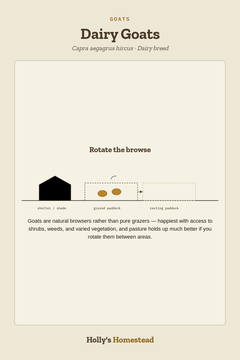
Dairy goats (Saanen, Toggenburg, British Alpine, Anglo Nubian, Australian Melaan and Brown, plus Nigerian Dwarf and LaMancha) give milk and need milking twice a day for most of the year, so they tie you to a routine. Meat goats such as the Boer and rangeland types suit larger blocks and need less daily work. Both are browsers rather than grazers, so they want shrubs, shade and shelter, not just grass. Our dairy goat guide and meat goat guide cover each in detail.
Goats are herd animals: keep at least two. A single goat will be stressed and noisy.
Registration, tags and council rules
A PIC (property identification code) is a legal requirement for anyone who keeps sheep, cattle or goats, whatever the number. You also need a movement document (an NVD, or in Victoria the consignment declaration) whenever goats leave or arrive, even if sold as pets. Electronic ID (eID) is being phased in:
| State | What to check | Rules tool |
|---|---|---|
| NSW | PIC required for any number. eID tag before leaving the property for animals born from 1 Jan 2025, and all sheep and farmed goats from 1 Jan 2027. Animals that never leave the property of birth are exempt | Council rules |
| Victoria | PIC required (free). eID tags for sheep and non-exempt goats; dairy and miniature goat breeds do not need electronic tags but still need a movement document and NLIS record | Council rules |
| Queensland | PIC required for any number. eID for animals born from 1 Jan 2025 and all animals from 1 Jan 2027 | Council rules |
| South Australia | PIC required. eID for animals born from 1 Jan 2025 and all from 1 Jan 2027, regardless of numbers or whether they are kept as pets | Council rules |
| Western Australia | PIC required. All sheep and goats must be eID tagged before leaving any property from 1 July 2026; receiver records the movement within 48 hours | Council rules |
| Tasmania | PIC required. eID for newborns from 1 Jan 2025 and all from 1 Jan 2027; applies to backyard owners | Council rules |
| Northern Territory | PIC required, with an NT waybill for movements; the national plan lists 1 Jan 2025 for eID (not re-checked) | Council rules |
| ACT | PIC required; the national plan lists 1 Jan 2025 for eID (not re-checked) | State rules |
Checked 7 October 2026. Rules are changing quickly, so confirm dates with your state agency. See our PIC glossary entry and state-by-state livestock rules.
Councils set their own limits on goats and fences, so find yours with My Council in One Place and read the permits and fees article before you buy.
Fencing, shelter and how many goats per hectare
Goats test fences. NT DAF recommends 1.5–1.8 m with buried mesh and no barbed wire for the Top End, and our Goat Paddock Planner advises 1.5 m for larger breeds, with mesh openings of 10 cm or less (horned goats can get their heads stuck in 10–15 cm gaps). Aim for 1.5 m (1.2 m is the bare minimum), and see heavy-duty livestock fencing and fencing basics. Portable electric netting works for miniature goats. Provide a dry, draught-free shelter and something for goats to climb on.
Stocking is measured in DSE (dry sheep equivalents, the feed eaten by a 45–50 kg dry sheep). MLA rates a 40 kg dry goat at about 0.9 DSE, but a breeding doe rises from 0.8 to 1.8 DSE in spring lactation. Use the Stocking Rate & Grazing Planner for your paddock, and note that it uses a flat 1 DSE per goat, which understates lactating does and the Goat Paddock Planner counts 1.5. For small blocks with bought-in feed, one retailer suggests about 1,000 m² (a quarter acre) for a couple of miniature goats. Our planner separates the two cases: about 18.6 m² per goat is a hay-fed yard minimum, while goats living off pasture and browse need far more (about 1,900 m² each at 8 DSE/ha and 1.5 DSE per goat; SA’s Landscape Board rates a dry milk or meat goat at 1.5 DSE, higher than MLA’s 0.9). Rotating paddocks also breaks the worm cycle: see rotational grazing.
Worms: the main killer
Internal parasites, especially barber’s pole worm, are a leading cause of goat deaths in warm, wet areas. WormBoss recommends not drenching on a calendar. Instead, check body condition score monthly (target 2.5–3.0, and 3.0 at kidding) and use the FAMACHA eye-colour card weekly in risk periods. For a smallholder program, drench if condition score is 2.0 or less, FAMACHA is 4–5, or goats are scouring. Do faecal egg counts (WormTest) every 4–6 weeks in summer and 6–8 weeks in winter, and after rain of 20 mm or more, and test for drench resistance (DrenchTest) every 2–3 years. Goats metabolise drenches faster than sheep, and most sheep drenches are not registered for goats, so a vet prescription is often needed. Treat newly bought goats with a quarantine drench before they join the herd. Barbervax is registered for sheep only; use in goats is off-label under a vet’s direction. See drenching.
Vaccines, diseases and minerals
Ask a vet about a clostridial vaccine (5-in-1 or 6-in-1) from about six weeks of age. NT DAF recommends it for goats, but several products are labelled for sheep only, so goat use may be off-label. Caprine arthritis encephalitis (CAE) and Johne’s disease have no cure. CAE spreads mainly through milk and colostrum, so buy from accredited herds, test goats over six months and follow the National Kid Rearing Plan. For Johne’s, Gudair vaccine, a closed herd and a Goat Health Statement help.
Minerals differ by region: DPIRD WA says copper, selenium and cobalt need regular monitoring in dairy goats, and NSW DPIRD notes copper deficiency is particularly severe on coastal properties. This is the opposite of sheep, which are easily poisoned by too much copper, so do not feed goat feed to sheep. Poisonous plants include oleander, yew, cherry and plum (Prunus), foxglove, rhododendron and azalea, and (in the NT) ironwood. Treat the NSW list as cattle-centred and check goat specifics.
Our milking guide covers the stand and routine. We have not verified the legality of selling or sharing raw goat milk, so check your state dairy authority first.
Breeding, kidding and production
DPIRD WA gives a heat cycle of 18–21 days, first mating at about 19 months for dairy does, a gestation of about five months and an average of about two kids per mating. Our calculator assumes 1.5 kids per doe, so adjust it for your herd. Dairy goats average 2–3 L a day (up to 4 L at peak) over roughly 300 days. See kidding, colostrum and mastitis.
Home kill: NSW allows meat from an animal you kill at home to be eaten by you and visiting family and friends, but not sold, traded or served to paying guests (NSW Food Authority). Queensland is stricter: only people living on the property may eat it, it cannot leave the property and cannot be traded (Safe Food Queensland). We have not verified the other states, so check with your state food regulator. Our home slaughter guide covers the process.
Costs and feed
Feed is the biggest running cost. Dairy goats need about 4–5% of bodyweight in dry matter a day (NT DAF), more than the 3% hay assumption in our Livestock Feed & Hay Budgeter. Run your numbers through the Goat Cost & Payback Calculator, whose defaults ($6/L milk, $14/kg meat, $15 per doe a year for treatment) we have not checked against current prices. A vet-prescribed drench and vaccines will likely cost more than that treatment default.
How goats change with your climate zone
Set your zone to see what applies to you.
Tropical
Barber’s pole worm and parasite loads are a leading cause of death, and dry-season pasture is low in protein. Use mineral licks, raised feeders and shade goats can climb.
Subtropical
Warm, wet weather keeps barber’s pole worm a persistent problem. Monitor often and ask your vet about control.
Warm Temperate
Coastal soils can mean copper deficiency, and selenium and cobalt can be low on sandy or granite soils. Use the east coast WormBoss program.
Mediterranean
Winter-rainfall scour worms are the main parasite problem. Hot dry summers need shade, water and a plan for the summer feed gap.
Cool Temperate
Scour worms and liver fluke are the main issues in Tasmania. Keep goats dry, and shelter kids from cold, wet, windy weather.
Arid
Water and shade matter most; our planner assumes 5 L per head a day, doubling in heat. Feed costs are high and carrying capacity low.
Not sure of your zone? Use Find My Climate Zone.
Watch and learn
Video transcript
Intro: Holly's Homestead.
Title card: Dairy Goats — difficulty: Moderate.
Quick reference: Space: 4–5m² shelter, 200m²+ browsing area per goat (more if they live off pasture: about 1,900m² each at 8 DSE/ha); Diet: Pasture/browse + hay + dairy goat pellets while milking; Water: Constant fresh access, high intake while lactating; Temperament: Intelligent, social, can be escape artists; Lifespan: 10–15 years.
Housing & setup: Shelter: Dry, draft-free shelter — goats dislike rain far more than cold.
Daily care: Milk twice daily at consistent times once in lactation.
Health & problems: Bloat — from sudden access to rich, wet pasture; introduce new feed gradually.
Production & harvest: Yield: 2–4 litres of milk per day at peak lactation, breed-dependent.
Outro: free printable A4 guide at hollyshomestead.com.au.
Video transcript
Intro: Holly's Homestead.
Title card: Meat Goats — difficulty: Easy–moderate.
Quick reference: Space: 3–4m² shelter, 150m²+ browsing area per goat (more if they live off pasture: about 1,900m² each at 8 DSE/ha); Diet: Pasture/browse + hay, less supplementary feed than dairy types; Water: Constant fresh access; Temperament: Generally calmer than dairy breeds; Lifespan: 10–12 years if kept beyond meat age.
Housing & setup: Shelter: Dry, draft-free shelter, similar to dairy goats but a simpler setup is fine.
Daily care: Provide good browse and pasture as the main feed base.
Health & problems: Worms — monitor and manage as part of routine care.
Production & harvest: Processing age: 6–14 months depending on breed and desired size.
Outro: free printable A4 guide at hollyshomestead.com.au.
Video transcript
Intro: Holly's Homestead.
Title card: Milking Sheep & Goats — difficulty: Moderate.
Quick reference: Difficulty: Moderate; Time: 10–20 min/animal; Cost: Low–moderate (stand/equipment); Best Season: Through lactation, 8–10 months typically; Frequency: Twice daily.
What you'll need: A raised milking stand with a head restraint and feed trough
Method: 1. Bring the animal onto the stand and secure the head restraint, offering feed to keep her settled.
Troubleshooting: Low milk yield — check feed quality, milking frequency and completeness, and rule out mastitis or a health issue.
Timing & maintenance: Best time: Twice daily at consistent times, roughly 12 hours apart, throughout the 8–10 month lactation.
Outro: free printable A4 guide at hollyshomestead.com.au.
Video transcript
Intro: Holly's Homestead.
Title card: Butchering Lamb & Goat — difficulty: Moderate–hard.
Quick reference: Difficulty: Moderate–hard; Time: 1–2 hrs; Cost: Low (knives) once set up; Best Season: Any time, cooler weather easier; Frequency: As animals reach processing age.
What you'll need: A sharp boning knife and a butcher's saw for bone
Method: 1. Hang or support the carcass securely for the initial breakdown.
Troubleshooting: Uneven or ragged cuts — usually knife technique or an insufficiently sharp blade; keep knives properly sharpened throughout the process.
Timing & maintenance: Best time: Any time, though a cool work environment (or cooler weather) makes the process considerably easier and safer.
Outro: free printable A4 guide at hollyshomestead.com.au.
Every guide, tool and rule page for goats
Everything on this site that applies to goats, in one place.
Animal guides
- Dairy Goats: animal guide
- Meat Goats: animal guide
- Keeping Dairy Goats: deep dive
- Keeping Meat Goats: deep dive
- All goat guides
How-to guides
- Milking Sheep & Goats
- Cheesemaking Basics
- Yoghurt & Cultured Dairy
- Butchering Lamb & Goat
- Home Slaughter: Process & Regulations
- Heavy-Duty Livestock Fencing
- Rotational Grazing
Rules and costs
- Backyard livestock rules by state
- Best states for backyard livestock
- Council permits and livestock fees
- Queensland council livestock rules
- NSW council livestock rules
- Victoria council livestock rules
- South Australia council livestock rules
- Western Australia council livestock rules
- Tasmania council livestock rules
- NT council livestock rules
Related reading
Words worth knowing
Frequently Asked Questions
Do I need a PIC for a pet goat?
Yes. A PIC is required for anyone who keeps sheep, cattle or goats, regardless of number, and eID rules apply even to pets in states such as South Australia.
Do goats need electronic ID tags?
Mostly yes. Western Australia requires them for all sheep and goats from 1 July 2026. NSW, Queensland, SA and Tasmania require them for animals born from 1 January 2025 and for all animals from 1 January 2027. Victoria exempts dairy and miniature breeds from electronic tags, but they still need movement documents.
How high should a goat fence be?
Treat 1.2 m as a minimum and aim for 1.5 m or more, with mesh openings of 10 cm or less. NT DAF recommends 1.5–1.8 m with buried mesh.
How many goats can I keep per hectare?
It depends on rainfall and pasture. Use DSE: a 40 kg dry goat is about 0.9 DSE, but a lactating doe can reach 1.8 DSE. Our stocking planner works this out for your paddock.
How often should I drench goats?
Not on a calendar. WormBoss advises monitoring body condition and FAMACHA, doing faecal egg counts, and drenching only when needed, with a vet prescription for most products.
Why can’t I keep just one goat?
Goats are herd animals and a lone goat is stressed and noisy: keep at least two.
How much milk does a dairy goat give?
About 2–3 L a day on average, up to 4 L at peak, over roughly 300 days.
Sources: Integrity Systems: registering for a PIC · NSW DPI: sheep and goat eID explained · Business Queensland: sheep and goat identification · Agriculture Victoria: owning, keeping and moving sheep and goats · NRE Tasmania: sheep and goat eID · WA DPIRD: sheep and goat eID · Stock Journal: mandatory eID by 2027 · WA DPIRD: introduction to dairy goat farming · NT DAF: care of goats in the Top End · WormBoss: goat program for smallholders · WormBoss: Barbervax in goats · MLA: goat livestock numbers · Animal Health Australia: CAE fact sheet · Farm Biosecurity: Johne’s disease in goats · NSW DPIRD: copper in goats · SA Landscape Board: grazing stocking rates · Shire of Donnybrook-Balingup: stocking rates policy · NSW Food Authority: home kill · Safe Food Queensland: home kill