Safety & regulatory note: home meat processing involves food safety and hygiene considerations, and requirements vary by state and by whether meat is for personal use or sale. Check with your state's food safety authority before proceeding. See our Terms of Use for more.
Holly's Homestead — Meat Processing & Butchery
Butchering Lamb & Goat
Break a carcass down into usable cuts
DIFFICULTY Moderate–hard
TYPE One-off task per animal
TIME 1–2 hours per carcass
TYPE One-off task per animal
TIME 1–2 hours per carcass
Difficulty
Moderate–hard
Time
1–2 hrs
Cost
Low (knives) once set up
Best Season
Any time, cooler weather easier
Frequency
As animals reach processing age
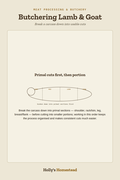
01Primal cuts first, then portion
Break the carcass down into primal sections — shoulder, rack/loin, leg, breast/flank — before cutting into smaller portions; working in this order keeps the process organised and makes consistent cuts much easier.
02What you'll need
- A sharp boning knife and a butcher's saw for bone
- A stable, clean work surface, ideally at a comfortable height
- Meat-safe containers or wrap for the resulting cuts
- A hanging or support method for the carcass during initial breakdown
03Method
- 1. Hang or support the carcass securely for the initial breakdown.
- 2. Separate into primal sections: shoulder, rack/loin, leg, and breast/flank.
- 3. Break each primal down further into your preferred retail cuts (chops, roasts, diced meat).
- 4. Trim excess fat and connective tissue as you go, setting trim aside for rendering if wanted.
- 5. Wrap or package cuts promptly and chill or freeze without delay.
04Troubleshooting
- Uneven or ragged cuts — usually knife technique or an insufficiently sharp blade; keep knives properly sharpened throughout the process.
- Difficulty finding joints when breaking down primals — take time to feel for the joint rather than sawing through bone; most breakdown follows natural joints with a knife.
- Meat warming up too much during a long session — work in a cool environment, and chill cuts as you finish them rather than leaving everything out until the end.
- Unsure of a specific cut's name or use — reference a labelled cuts diagram for the species; naming conventions do vary somewhat by region.
05Timing & maintenance
Best time
Any time, though a cool work environment (or cooler weather) makes the process considerably easier and safer.
Duration
1–2 hours per carcass once reasonably practised.
Maintenance
Not applicable per event; ongoing knife maintenance supports every session.
Signs of success
Clean, well-organised cuts, wrapped and chilled promptly, with minimal waste.
06Tips & variations
Pairs well with
Home Slaughter — Process & RegulationsCuring & Smoking MeatTool Maintenance & SharpeningCommon mistakes
Working with dull knives, leading to ragged cuts and more effortLeaving cuts sitting out at room temperature for too long during a long sessionPro tip
A properly sharp knife makes far more difference to butchering ease than brute force — sharpen before you start, not partway through when you notice it dragging.