
Keeping Quail in Australia: The Complete Guide
Quail are the smallest backyard livestock: they fit in a tiny space, lay almost daily and mature in weeks. But legality depends on the species and state (Western Australia needs a permit for Japanese quail), the right feed is a high-protein game bird crumble, not layer pellets, and in cooler areas they stop laying in winter unless they get about 14 hours of light.
 Printable one-page guide
Set your climate zone and this page will show what to do with quail where you live, what to watch for right now, and the rules for your state. It stays on this device. Find my climate zone
Are quail right for you?
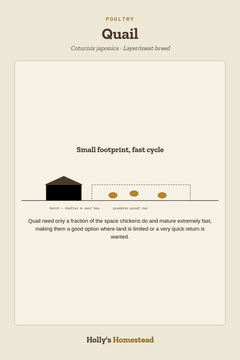
Quail suit small blocks, renters with permission and anyone who wants eggs and meat from very little space. Coturnix (Japanese) quail start laying at about six to eight weeks and can lay 200–300 small eggs in their first year, but they live only two to three years and are usually processed for meat at six to eight weeks. Males make a shrill call rather than a crow, so they can suit places where roosters are banned, though you should still check council noise rules. They are fragile compared with chickens and need warmth, light and clean housing. Compare your options in Chickens vs Ducks vs Quail.
Is it legal? Check species, state and council
Quail legality is the least obvious rule in backyard livestock, and it depends on the species. We could confirm the following, but not every state:
- Western Australia: Japanese quail are a “restricted bird” and need a keeping permit from DPIRD Wildlife Licensing, with enclosures of 7 mm square mesh. Permits can take up to 30 working days. Confirm with DPIRD whether it applies to you before you buy.
- NSW: you do not need a licence to keep exotic (non-native) birds, and 41 native species including brown, king and stubble quail are licence-free (NSW Environment). Japanese quail are not named, but are exotic.
- Victoria: non-indigenous quail, plus stubble, king and Californian quail, are on the list of birds that may be held privately without a wildlife licence (2020 list).
- Qld, SA, Tas, NT, ACT: we could not verify the rules, so check with your state wildlife or environment department.
Councils often class quail as “other poultry”. Kempsey Shire (NSW), for example, treats quail and turkeys as other poultry with a 30 m setback from dwellings, compared with 4.5 m for fowl. Find your council with My Council in One Place.
| State | What to check | Rules tool |
|---|---|---|
| NSW | No licence needed for exotic birds or common native quail; PIC at 100 or more; NSW Food Authority licence over 100 birds, notification at 100 or fewer; council classes may require large setbacks | Council rules |
| Victoria | Non-indigenous quail may be held without a wildlife licence; egg standard applies to quail eggs; PIC at 50 or more poultry | Council rules |
| Queensland | Species rules not verified; biosecurity entity registration at 100 or more birds; council limits depend on block size | Council rules |
| South Australia | Species rules not verified; council sets limits; enclose aviaries because of wild-bird H5N1 activity | Council rules |
| Western Australia | Japanese quail are a restricted bird: a DPIRD permit and 7 mm mesh enclosure; poultry registration at 50 or more; council sets numbers | Council rules |
| Tasmania | Species rules not verified; check council rules | Council rules |
| Northern Territory | Species rules not verified; every property with poultry needs a free PIC | Council rules |
| ACT | Not verified here: see the state-by-state rules article | State rules |
Checked 7 October 2026. State poultry registration rules cover quail, and legality of keeping a species is a separate question. See our state-by-state livestock rules.
Bird flu. H5N1 reached wild birds on the mainland in June 2026. Quail in open aviaries are exposed to wild-bird droppings, so use a roofed, fine-mesh aviary, cover feed and water, and report sick or dead birds on 1800 675 888. See our bird flu article.
Housing, space and predators
Quail live in a covered aviary or a hutch with a solid floor and deep litter. A Victorian council-backed guide recommends no more than about three birds per square metre (ten hens needs just over 3 m²), 10–15 cm of deep litter and no gaps over 10 mm so rats and snakes cannot get in. Our Quail Aviary Planner uses about 0.25 m² per bird, which is close to that, while our older quail guide quotes a tighter 0.1 m², so use the larger figure. Keep the height low (30–45 cm in the planner) or soft-roofed, because quail flush straight upward when startled and can injure themselves. Use 7–10 mm mesh; 13 mm lets ants, snakes and rats in. Protect them from draughts and damp.
Feed, light and water
Quail need more protein than chickens. A commercial guide suggests starter at about 28–30% protein for the first six weeks, grower at 22–24%, and layer at 24–26% with 2.5–3.5% calcium, with adults eating about 14–18 g a day. Ordinary layer pellets are too low in protein, so buy game bird or quail crumble. Our quail cost calculator uses a cheaper default feed price, so adjust it to the price you will really pay. Use shallow water containers that chicks cannot drown in.
Light: Coturnix quail generally need about 14 hours of light a day to keep laying (a widely repeated figure we could not confirm in a scientific source). That matters in cooler zones: do not assume they lay all year without extra lighting.
Eggs, breeding and meat
Quail eggs are small and sell well. Eggs hatch in 17–18 days (our Incubation Day-by-Day Planner uses 18). Keep about one male to four or five females; surplus males fight, so most keepers process them at six to eight weeks. If you sell eggs, Victoria’s egg standard applies to quail eggs: cartons need the producer’s name and address and a best-before date, with 35 days recommended, and cracked or dirty eggs cannot be sold. In NSW, poultry farms of more than 100 birds, including quail, need a Food Authority licence and smaller ones notify. For processing, see processing a chicken, which covers the same hygiene principles.
Health
Common problems include worms, coccidiosis (worse in wet seasons), respiratory disease, egg binding and cannibalism when birds are crowded or bored. Prevention is hygiene: dry litter, clean water, enough space and quarantining new birds. Because quail are small and fragile, deaths happen quickly, so check them daily. Ask a vet or your state department about any unexplained deaths.
What it costs
Quail are cheap to buy, often $5–$30 each, with housing from $150–$400 in some sources. The real cost is feed, because quail need high-protein feed. Use the Backyard Quail Cost & Payback Calculator with your own prices.
How quail change with your climate zone
Quail are small, so heat, cold and damp hit them quickly. Set your zone to see what applies to you.
Tropical
The main risks are heat above 35°C with humidity, coccidiosis in the wet season and ants, snakes and rats through large mesh. Laying is likely year-round.
Subtropical
Heat and humidity are the main risks, so provide shade and cross-ventilation. Laying is likely year-round.
Warm Temperate
The easiest zone: shade and wind protection are usually enough, with extra light in winter.
Mediterranean
Summer heat spikes of 40°C or more are dangerous: shade cloth, evaporative cooling and ember-resistant aviary materials matter.
Cool Temperate
Winter laying drops without about 14 hours of light, and cold stress reduces activity. Draught-proof, dry housing is essential.
Arid
Extreme heat and dust: provide a dust bath, a double-roof shade, water twice a day and wind protection.
Not sure of your zone? Use Find My Climate Zone.
Watch and learn
Video transcript
Intro: Holly's Homestead.
Title card: Quail — difficulty: Easy.
Quick reference: Space: 0.1m² per bird, keep in colonies; Diet: Game bird/quail crumble, high protein; Water: Fresh daily, shallow dish to avoid drowning chicks; Temperament: Skittish, best left undisturbed; Lifespan: 2–3 years.
Housing & setup: Shelter: Solid-sided enclosure with a covered top — quail fly straight up when startled and can injure themselves on mesh roofs.
Daily care: Provide a covered enclosure — quail startle upward and need a soft or high ceiling.
Health & problems: Injury from startling — the main risk; ensure a soft or sufficiently high covered top.
Production & harvest: Yield: Up to 300 tiny eggs a year per hen in good layer lines.
Outro: free printable A4 guide at hollyshomestead.com.au.
Every guide, tool and rule page for quail
Everything on this site that applies to quail, in one place.
Animal guides
How-to guides
Rules and costs
- Backyard livestock rules by state
- Best states for backyard livestock
- Council permits and livestock fees
- Queensland council livestock rules
- NSW council livestock rules
- Victoria council livestock rules
- South Australia council livestock rules
- Western Australia council livestock rules
- Tasmania council livestock rules
- NT council livestock rules
Related reading
Words worth knowing
Frequently Asked Questions
Is it legal to keep quail in Australia?
It depends on the species and state. Western Australia requires a permit for Japanese quail. NSW does not require a licence for exotic birds or for common native quail, and Victoria lists non-indigenous quail as holdable without a wildlife licence. We could not verify Qld, SA, Tas, NT or the ACT, so check with your state department.
Are quail noisy?
Males make a shrill call rather than a crow, so they are quieter than roosters, but they are not silent. Councils may still class them as other poultry, so check noise rules.
How much space do quail need?
A Victorian council-backed guide recommends no more than about three birds per square metre. Our aviary planner uses about 0.25 m² per bird.
What should I feed quail?
A high-protein game bird or quail crumble: about 28–30% protein as starter, 22–24% as grower and 24–26% for layers, according to a commercial guide. Layer pellets alone are too low in protein.
Do quail lay all year?
Only with enough light: they generally need about 14 hours a day. In cooler areas, laying drops in winter without extra lighting.
How long do quail live?
Coturnix quail typically live two to three years, but most are processed for meat at six to eight weeks.
Sources: WA DPIRD: keeping introduced animals · NSW: birds you don’t need a licence to keep · My Smart Garden: urban quail keeping (Victorian councils) · Grain Shed: quail farming for beginners · Agriculture Victoria: egg production standard · NSW Food Authority: poultry licensing · Kempsey Shire poultry policy