
Keeping Turkeys in Australia: The Complete Guide
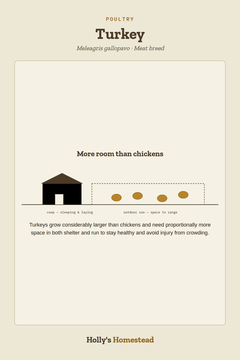
Turkeys are big, hardy birds that need much more space than chickens, and toms are loud enough that some councils treat them like roosters. The two things that kill backyard turkeys are blackhead disease (never keep them on ground chickens have used) and foxes at night. For a Christmas bird, heritage breeds take 24 weeks or more, so hatch by mid year.
 Printable one-page guide
Set your climate zone and this page will show what to do with turkeys where you live, what to watch for right now, and the rules for your state. It stays on this device. Find my climate zone
Are turkeys right for you?
Turkeys suit people with space who want a home-raised bird for the table, especially at Christmas. They are often docile, grow large (Bronze toms around 13 kg and hens around 8 kg, according to a Burke’s Backyard fact sheet), and breeding stock can live seven to nine years. Toms gobble loudly and are too noisy for most suburban yards. Commercial birds are killed at about 10 weeks for hens and 18 weeks for toms, but those fast-growing broad-breasted birds are not generally sold to home keepers, and heritage breeds mature more slowly.
Check the rules first: noise, councils and states
Councils increasingly regulate tom turkeys. Armidale Council (NSW) exhibited a proposal in 2023 to treat tom turkeys like roosters, which are banned in residential zones, with a maximum of 20 hens (we could not confirm the outcome). Kempsey Shire classes turkeys and quail as “other poultry” with a 30 m setback from dwellings, compared with 4.5 m for fowl. In WA, the common turkey is on the exempt bird list, so no permit is needed if turkeys are the only species you keep. Find your council with My Council in One Place.
| State | What to check | Rules tool |
|---|---|---|
| NSW | PIC at 100 or more; NSW Food Authority licence over 100 birds (notification for fewer); councils may treat tom turkeys like roosters (Armidale proposal) or class turkeys as other poultry (Kempsey 30 m setback) | Council rules |
| Victoria | PIC at 50 or more poultry (free); egg stamping with your PIC at 50 or more; H5 housing order in listed southern and coastal council areas for flocks of 50+ | Council rules |
| Queensland | Biosecurity entity registration at 100 or more birds; avian influenza must be reported; council limits depend on block size | Council rules |
| South Australia | Council sets limits (Mitcham counts ducks and geese as poultry); enclose runs because of wild-bird H5N1 activity | Council rules |
| Western Australia | Common turkey is on the exempt bird list (no permit if it is the only species kept); registration at 50 or more poultry; council sets numbers | Council rules |
| Tasmania | Council rules; egg sellers should follow council food safety guidance (clean, stamped eggs in new cartons) | Council rules |
| Northern Territory | Every property with poultry needs a PIC (free); Alice Springs has no numerical limit or permit | Council rules |
| ACT | Not verified here: see the state-by-state rules article | State rules |
Checked 7 October 2026 from state department pages. Poultry registration rules cover turkeys. See our state-by-state livestock rules. NSW Food Authority licensing covers poultry including turkeys: farms over 100 birds need a licence, and smaller ones notify.
Bird flu. H5N1 reached wild birds on the mainland in June 2026. Turkeys on open runs are exposed to wild-bird droppings: use a roofed, fine-mesh run, cover feed and water, and report sick or dead birds on 1800 675 888. See our bird flu article.
Blackhead: the disease to understand first
Blackhead (Histomonas meleagridis) is the main killer of young turkeys. It spreads through the eggs of caecal worms in soil, chickens can carry and transmit it without being ill, and earthworms can carry it too. There is no effective treatment. Turkey losses are highest between about 3 and 18 weeks. Symptoms include a blackened comb and face, yellow droppings and a stiff gait. Prevention is hygiene: keep turkeys separate from chickens, on well-drained, sunny ground that you rest or move, with feeders moved regularly and hard floors where you can, and use medicated feed for young birds. See Biosecurity Queensland’s blackhead page below. Blackhead is reported to be more common in summer in Queensland.
Space, fencing and predators
Plan for far more space than chickens. NSW Education’s turkey guidelines suggest about 15 m² of pasture per bird, a 2 m fence with an enclosed roof and mesh dug about 20 cm into the ground. Our Turkey Housing Planner uses about 0.5 m² of shelter and 2 m² of run per bird as a working minimum, and our turkey guide suggests 0.3–0.5 m² of shelter and a large run, so treat those as the least you can use and give them more. Foxes are the main loss, especially at night, so shut birds in every dusk. Young turkeys fly well, so clip the flight feathers on one wing. Birds are comfortable at about 20–28°C and stressed below 10°C and above 32°C. Signs of heat stress are panting, drooping and a dark head.
Feed and water
Turkeys need much more protein than chickens when young. NSW Education suggests about 28% protein for weeks one to four, 24% for weeks five to eight and 20% after eight weeks, with water troughs allowing about 15 cm per bird and shallow water for poults. A medicated turkey starter in one Queensland store cost about $1.90/kg in 2026, higher than the $1.45/kg our cost calculator assumes, so adjust the price. Poults need a brooder: start at about 38°C and reduce by 1–2°C every three days to about 21°C at four to six weeks, with about 900 cm² per poult under the brooder (see brooder).
Breeds, breeding and the Christmas bird
Heritage breeds include Bronze, Bourbon Red, Narragansett, Slate and Royal Palm. The Rare Breeds Trust of Australia lists ten colour varieties, with Bourbon Red and Bronze on its watch list. Hens lay a clutch of 12 to 18 eggs and incubate for 28 days; the breeding season is roughly September to December, with about one tom to two hens, according to one breeder. Use the Incubation Day-by-Day Planner for the schedule.
For Christmas, count back: commercial hybrids reach 5–11 kg in 10–18 weeks, but heritage birds take 24 weeks or more, so hatch heritage poults by about June or July in warm areas. Our guide says 16–24 weeks and 5–10 kg dressed, which suits heritage birds at the slow end. For processing, see processing a chicken and home slaughter rules, and check your state rules before selling meat.
What it costs
Poults cost about $25–$50 each in one fact sheet, and feed is the biggest ongoing cost. Our calculator assumes 80–120 eggs a season for turkeys, which we could not source: a breeder describes clutches of 12 to 18 eggs, so adjust that in the Backyard Turkey Cost & Payback Calculator.
How turkeys change with your climate zone
Set your zone to see what applies to you.
Tropical
Blackhead is worse in warm, wet months. Heat above 32°C stresses turkeys, so provide shade and keep poults dry in the wet season.
Subtropical
Blackhead is more common in summer in Queensland. Shade, sprinklers and well-drained, rested ground help.
Warm Temperate
A good all-round zone. For Christmas, hatch heritage poults by about June or July.
Mediterranean
Hot dry summers need shade and water. Timber shelters are a fire risk, and fox pressure is high.
Cool Temperate
Poults need heat for longer and wet ground and cold are the killers. Hatch later with a heated brooder.
Arid
Heat stress and water volume are the limits, with fox and dog pressure. A large shaded run is essential.
Not sure of your zone? Use Find My Climate Zone.
Watch and learn
Video transcript
Intro: Holly's Homestead.
Title card: Turkey — difficulty: Moderate.
Quick reference: Space: 0.3–0.5m² shelter, large run preferred; Diet: Turkey-specific grower feed, higher protein than chicken feed; Water: Fresh daily, high intake; Temperament: Docile but can be flighty when young; Lifespan: Kept typically one season for meat.
Housing & setup: Shelter: Sturdy, weatherproof shelter with roosts strong enough for a large bird.
Daily care: Feed a turkey-specific grower ration — chicken feed alone isn't sufficiently high in protein.
Health & problems: Blackhead disease — a serious parasite risk, especially if housed with or after chickens; avoid shared ground.
Production & harvest: Processing age: 16–24 weeks depending on breed and target size.
Outro: free printable A4 guide at hollyshomestead.com.au.
Every guide, tool and rule page for turkeys
Everything on this site that applies to turkeys, in one place.
Animal guides
How-to guides
Rules and costs
- Backyard livestock rules by state
- Best states for backyard livestock
- Council permits and livestock fees
- Queensland council livestock rules
- NSW council livestock rules
- Victoria council livestock rules
- South Australia council livestock rules
- Western Australia council livestock rules
- Tasmania council livestock rules
- NT council livestock rules
Related reading
Words worth knowing
Frequently Asked Questions
Can turkeys live with chickens?
It is risky. Chickens can carry the parasite that causes blackhead without being ill, and blackhead has no effective treatment in turkeys. Keep them on separate ground.
Are turkeys noisy?
Toms gobble loudly and are described as too noisy for suburban yards. Some councils treat tom turkeys like roosters or class turkeys as other poultry with larger setbacks.
How much space do turkeys need?
NSW Education guidelines suggest about 15 m² of pasture per bird. Our planner uses about 2 m² of run per bird as a working minimum, so give them as much as you can.
When should I hatch turkeys for Christmas?
Commercial hybrids take 10–18 weeks, but heritage birds take 24 weeks or more, so hatch heritage poults by about June or July in warm areas.
How big do turkeys get?
A Bronze tom is around 13 kg and a hen around 8 kg, according to a Burke’s Backyard fact sheet.
How hot is too hot for turkeys?
NSW Education guidelines suggest turkeys are comfortable at about 20–28°C and stressed below 10°C and above 32°C. Panting, drooping and a dark head are signs of heat stress.
Sources: Biosecurity Queensland: blackhead · NSW Education: turkey environment · NSW Education: turkey food and water · NSW Education: turkey health · Burke’s Backyard: turkey road test · Rare Breeds Trust: turkey varieties · WA DPIRD: restricted bird list · RSPCA: how turkeys are farmed