
Keeping Chickens in Australia: The Complete Guide
Chickens are the easiest livestock to start with, but the rules now matter more than the coop: council limits vary block by block, Victoria, WA, Qld, NSW and the NT each set their own registration rules, and H5N1 bird flu has reached wild birds in the south and east since June 2026. A flock of four to six hens costs roughly $650–$1,100 to set up and pays back in eggs in about 12–20 months if you keep them safe and cool.
 Printable one-page guide
Set your climate zone and this page will show what to do with chickens where you live, what to watch for right now, and the rules for your state. It stays on this device. Find my climate zone
Is keeping chickens right for you?
For most households, yes. Chickens turn kitchen scraps and a little feed into eggs, they need about ten minutes of daily care, and they are forgiving of beginner mistakes. The honest costs are the up-front setup, a daily routine you cannot skip (let out, water, lock in at dusk, collect eggs), and the fact that a flock needs someone to look after it when you are away.
Decide three things before you buy anything: eggs, meat or both, how many birds your space and council allow, and whether you can fully predator-proof and, where needed, cover the run. If you are weighing chickens against other poultry, read Chickens vs Ducks vs Quail first. If you are renting or have no yard, see homesteading without a yard.
The rest of this guide follows the order that avoids expensive mistakes: rules, numbers, housing, birds, feed, health, eggs, meat, then cost.
Check the rules first: council, state and bird flu
Council rules come first. Limits are set by your council, usually by block size, and they change from one council to the next. In Moreton Bay (Qld), for example, a block under 300 m² may keep no chickens, 600–1,000 m² may keep six, and roosters are not allowed under 6,000 m². Alice Springs sets no numerical limit and needs no permit, but does not recommend roosters. Neighbours matter as much as the rules: a rooster is the most common reason for complaints, and you do not need one to get eggs. Use My Council in One Place to find your council, then the council-by-council tool for your state.
State rules sit on top. Registration is where most people get caught out, because the thresholds differ:
| State | What to check | Rules tool |
|---|---|---|
| NSW | PIC needed at 100 or more birds (NSW DPI); notification and licensing rules apply to egg sellers; council sets numbers | Council rules |
| Victoria | PIC at 50 or more birds (free; optional below); egg stamping with PIC at 50 or more; H5 housing order in listed southern and coastal council areas for flocks of 50+ | Council rules |
| Queensland | Biosecurity entity registration at 100 or more birds; avian influenza must be reported; council limits by block size | Council rules |
| South Australia | Council sets limits (Mitcham: 0.3 m² shelter per bird, 15 m from dwellings); South Australia had the most wild-bird H5 detections in the first months, so enclose runs | Council rules |
| Western Australia | Registration at 50 or more poultry ($80.36 for three years in 2024); council sets numbers; voluntary housing advice for commercial flocks ended 10 August | Council rules |
| Tasmania | Council rules; egg sellers should use clean, stamped eggs in new cartons with a best-before date of 35 days or less (Launceston council) | Council rules |
| Northern Territory | Every property with poultry needs a PIC (free); Alice Springs has no numerical limit or permit, and ponds must be cleaned every second day | Council rules |
| ACT | Not verified here: see the state-by-state rules article | State rules |
Checked 7 October 2026 from state department pages. Thresholds and fees change, and we could not confirm every state, so confirm with your department before you rely on a number. Our state-by-state livestock rules article and permits and fees guide go deeper.
Bird flu changes how you keep birds. H5N1 bird flu (clade 2.3.4.4b) was first detected on the Australian mainland in wild birds in June 2026, and hundreds of wild-bird detections followed across SA, Victoria, NSW, Tasmania and WA. As of early October 2026 we found no reports of detections in poultry. Victoria has ordered flocks of 50 or more birds in dozens of southern and coastal council areas to be housed, and recommends housing elsewhere; other states have issued advice. Official backyard advice is consistent: keep birds away from wild birds and their droppings, use a fully enclosed run with fine mesh and a roof, keep feed and water under cover, change footwear, and quarantine new birds (14 days in Agriculture Victoria advice, 30 days in the NT, NSW and Commonwealth advice, so use 30). Ducks and geese are the most susceptible. Report sick or dead birds on the Emergency Animal Disease Watch Hotline, 1800 675 888. Cooked eggs and chicken remain safe to eat. Our bird flu article covers biosecurity step by step, and the Agriculture Victoria control order page shows the current Victorian order.
How many chickens, and how much room
For eggs, a simple rule is to buy one and a half to two hens for every egg you want each day, because hens do not all lay at once and lay less in winter. A starter flock of four to five birds is a common recommendation, and never keep a single chicken alone, because they are flock animals. Four to six hens covers most households.
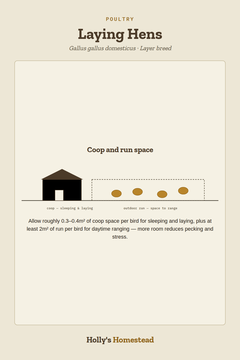
Councils set minimums, and a minimum is not the same as a happy flock. Mitcham council in South Australia asks for at least 0.3 m² of shelter per bird and for it to be 15 metres from dwellings. Our Chicken Coop Planner uses about 0.35 m² of coop and 1 m² of run per hen as a working minimum, while our laying hens guide suggests aiming for 2 m² of run if you can, because more room means less pecking and stress. Perches should be no more than about 60 cm high (WA DPIRD), with one nest box for every three or four hens.
If you want hens and meat birds, keep them in separate runs where possible: layers need a calcium-rich layer feed and meat birds need a high-protein grower feed, and a shared feeder suits neither.
Housing: coop, run and predators
Your coop has three jobs: keep birds dry and ventilated, keep them out of reach of predators at night, and be easy enough to clean that you actually do it. Most Australian guidance agrees on the basics: a solid weatherproof coop raised off the ground, plenty of ventilation without draughts at roost height, at least 8 cm of deep litter (shavings or straw), a run fenced to about 1.8 m or covered, and a 50 cm skirt of mesh bent outward at the base to stop foxes digging. Heat and ammonia are a bigger problem than cold in most of the country. In cool-temperate areas, damp and draughts matter more.
Predators vary by region: foxes and dogs almost everywhere, snakes and goannas in warmer areas, raptors in open country, and rats attracted to feed. Plan on locking birds in at dusk every night and storing feed in a lidded bin. Where bird flu is circulating, add a solid roof or fine-mesh cover so wild birds cannot drop into the run, and keep feeders and waterers under cover.
Build it yourself with our chicken coop how-to and cost it with the Chicken Coop Planner, which prices three budget tiers including the fencing. The glossary explains predator-proofing and deep litter, and our fencing basics guide covers the mesh.
Choosing and buying your birds
Most beginners buy point-of-lay pullets, hens about 16 to 24 weeks old that are about to start laying (see point of lay and pullet). Day-old chicks are cheaper but need a heated brooder and weeks of care. Prices in a 2022 Dine-A-Chook breakdown were roughly $30–$85 for a point-of-lay hen, $9–$30 for a pullet and $4–$35 for a day-old chick, so check current local prices. Buy vaccinated birds from a reputable breeder where you can, and quarantine every new bird for 30 days before it joins your flock.
Breed matters more than people expect. Commercial hybrids such as ISA Brown and Hy-Line lay the most eggs, roughly 270 in their first year of laying, then fall away. Heritage and dual-purpose breeds lay fewer, around 180 in year one, but often live and lay longer. For warm areas, Pip Magazine’s breed chart lists Ancona, Araucana, Frizzle and ISA Brown. For cool areas, Orpington, Plymouth Rock, Wyandotte and Silkie are common choices, and Silkie, Orpington and Pekin hens often go broody if you want to hatch your own. If you want to hatch eggs, the Incubation Day-by-Day Planner gives you the full 21-day schedule and a calendar file.
Feed and water
A laying hen eats about 120–130 g of layer feed a day, which is the figure used in both Northern Territory guidance and our own calculators. Layer pellets or crumble are balanced for calcium and protein, so they should be most of the diet. Offer grit (see grit) and extra shell grit for calcium, add greens and kitchen scraps as a treat, and keep scraps to a minor share, because scraps cannot replace a balanced feed. Never feed mouldy or spoiled food, and keep feed in lidded bins so rats and wild birds cannot get at it.
Water matters more than feed. A hen drinks roughly 250 ml a day in mild weather and far more in heat. Keep it fresh, shaded and in more than one place in summer. Layer feed costs roughly $22–$30 for a 20 kg bag in 2026, which works out at about $4–$7 per bird per month depending on how much they forage. Run your own numbers in the Livestock Feed & Hay Budgeter.
Health: worms, mites, vaccination and what to watch
Healthy chickens are bright, alert, active and eat well. Check them weekly: comb colour, breathing, droppings, feathers and the vent (see vent). Worm every three months, as NSW and NT guidance advises, and check for lice and mites. Red mite hides in coop cracks and bites at night, so treat the coop, not only the birds. Keep the coop dry, replace litter regularly and clean waterers.
Vaccination for backyard flocks is optional and often impractical: Marek’s disease vaccine is given to day-old chicks and sold in large vials, while fowl pox and infectious laryngotracheitis (ILT) vaccines also exist (RSPCA). Most backyard flocks are unvaccinated, which is why quarantine and hygiene matter so much. Some conditions need a vet, including egg-bound hens. Any unexplained sudden deaths, severe respiratory signs or swelling of the head should be reported to the hotline above. Always ask your vet about drugs, because withholding periods apply to eggs and meat.
Eggs: how many, how long, and selling them
A healthy hen lays four to six eggs a week at her peak, fewer in winter and while moulting (see moult). A hybrid lays about 270 eggs in her first year of laying and about 230 in her second, while a heritage hen lays about 180 and then 150. Shell quality and numbers decline each year, so most households replace or top up the flock every two to three years. The Flock Age & Replacement Planner shows when your flock will fall below the eggs you need and how many pullets to add. Chickens can live three to seven years, but they lay well for fewer. Plan for what happens to hens that stop laying, including rehoming or humane culling.
Handling and storage: collect daily, brush off dry dirt rather than washing with water, and do not eat cracked eggs. Tasmanian council guidance suggests storing eggs at about 15–20°C, and NSW DPI says refrigerated eggs keep up to six weeks. Selling or sharing: rules differ by state. Victoria requires egg stamping with a PIC for 50 or more birds and recommends it below that; NSW has notification and licensing thresholds for larger operations; Tasmanian councils expect clean, stamped eggs in new cartons with a best-before date. Selling eggs without checking your state rules can breach food safety laws, so see our selling and business rules tools for your state.
When the eggs pile up, try the egg recipes: classic frittata, egg custard, fresh egg pasta and egg fried rice.
Meat chickens
Meat breeds are a different project from layers. They grow fast, are processed at about 8–14 weeks, eat heavily on a high-protein ration, and can suffer leg problems if they grow too quickly, so plan your housing, processing date and freezer space before the chicks arrive. A pasture pen or chicken tractor that you move daily keeps birds clean and spreads manure. Start with the meat chickens guide, then read processing a chicken and home slaughter: process and regulations.
The legal side is state-specific. Rules on home processing, selling and sharing poultry meat differ, and we could not find one reliable Australian source covering every state, so check with your state’s primary industries or food authority before you sell any meat. For personal use, the practical limits are space, time and your own comfort with the job.
What it costs, and when it pays back
A flock of four to six hens typically costs roughly $650–$1,100 to set up if you build the coop yourself, or $1,400–$2,200 with a prefab coop and named breeds, then $4–$7 per bird per month to feed. Eggs alone usually pay back the setup in about 12–20 months, if you do not lose birds to predators or disease. That is the central finding of our chickens vs supermarket eggs cost breakdown. For your own numbers use the Backyard Chicken Cost & Payback Calculator, which lets you change feed, egg and setup prices. Cheaper birds and coops are false economies if a fox takes the lot.
How chickens change with your climate zone
Zone matters because the main chicken problems are heat, humidity, frost and predators, and they come in different mixes across Australia. The six zones below summarise what changes. Set your zone and the box at the top of this page will show the one that applies to you, plus what to watch this month. Some of this is general guidance rather than measured data, so treat it as a starting point.
Tropical
Heat, humidity, snakes and wet-season mould. Top End advice is a fully enclosed run with fine mesh buried at the base, tube feeders and a roosting shed.
Subtropical
Hot, humid summers and mild winters. Over about 29°C chickens are hot, so shade, ventilation and water matter. Council limits are often tied to block size.
Warm Temperate
Heatwaves and foxes are the main risks. Choose breeds that cope with heat and expect egg numbers to dip in winter.
Mediterranean
Hot dry summers and wet winters: water and shade in summer, drainage and dry litter in winter, and a plan for hens in a bushfire.
Cool Temperate
Frost, damp and short days. Moisture and poor ventilation cause more frostbite than cold alone. Pick cold-hardy breeds and avoid heaters in the coop.
Arid
Extreme heat is the limiting factor. Light-coloured birds, deep shade, plenty of cool water and a sheltered coop matter most.
Not sure which zone you are in? Use Find My Climate Zone, and see how timing differs between cool temperate and subtropical areas.
Watch and learn
Short video summaries of the guides above. Each opens with a transcript.
Video transcript
Intro: Holly's Homestead.
Title card: Laying Hens — difficulty: Easy.
Quick reference: Space: 0.3–0.4m² coop, 2m² run; Diet: Layer pellets + scraps + grit; Water: Fresh daily, ~250ml/bird; Temperament: Calm, easily handled; Lifespan: 6–10 years.
Housing & setup: Shelter: Weatherproof coop with roosting bars and one nest box per 3–4 hens, raised off the ground.
Daily care: Let out in the morning, lock in safely at dusk against predators.
Health & problems: Red mite — infest coop cracks at night; treat the coop, not just the birds.
Production & harvest: Yield: 4–6 eggs per week per hen in peak lay, tapering with age and season.
Outro: free printable A4 guide at hollyshomestead.com.au.
Video transcript
Intro: Holly's Homestead.
Title card: Meat Chickens — difficulty: Easy–moderate.
Quick reference: Space: 0.1–0.15m² per bird (grows fast); Diet: High-protein grower feed, free-choice; Water: Fresh daily, high intake as they grow; Temperament: Docile, low activity; Lifespan: Kept only 8–14 weeks.
Housing & setup: Shelter: Simple, well-ventilated shelter; mobile 'chicken tractors' work well to spread manure across pasture.
Daily care: Feed a high-protein grower ration free-choice — these breeds eat heavily.
Health & problems: Leg weakness — from very rapid growth in some breeds; choose slower-growing breeds if this is a concern.
Production & harvest: Processing age: 8–14 weeks depending on breed and target size.
Outro: free printable A4 guide at hollyshomestead.com.au.
Video transcript
Intro: Holly's Homestead.
Title card: Building a Chicken Coop — difficulty: Moderate.
Quick reference: Difficulty: Moderate; Time: 1–7 days; Cost: Moderate–high; Best Season: Before bringing home birds; Frequency: Built once, maintained ongoing.
What you'll need: Timber or another frame material
Method: 1. Plan for roughly 0.3–0.4m² of coop space per bird, plus an attached or separate run.
Troubleshooting: Predator getting in despite precautions — check every gap and latch carefully; predators exploit surprisingly small weaknesses.
Timing & maintenance: Best time: Build before bringing home birds, allowing time to get the design right without pressure.
Outro: free printable A4 guide at hollyshomestead.com.au.
Video transcript
Intro: Holly's Homestead.
Title card: Processing a Chicken — difficulty: Moderate.
Quick reference: Difficulty: Moderate; Time: 20–30 min; Cost: Low; Best Season: Any time; Frequency: As birds reach processing age.
What you'll need: A sharp knife and sturdy shears/scissors
Method: 1. Process using a humane method appropriate to the bird, then bleed thoroughly.
Troubleshooting: Feathers not releasing easily — scald water too cool or too brief; adjust temperature and timing slightly (too hot can start cooking the skin).
Timing & maintenance: Best time: Any time the bird has reached your target processing age.
Outro: free printable A4 guide at hollyshomestead.com.au.
Every guide, tool and rule page for chickens
Everything on this site that applies to chickens, in one place.
Animal guides
- Laying Hens: animal guide
- Meat Chickens: animal guide
- Keeping Laying Hens: deep dive
- Keeping Meat Chickens: deep dive
- All poultry guides
How-to guides
- Building a Chicken Coop
- Processing a Chicken
- Home Slaughter: Process & Regulations
- Fencing Basics
- Hot Composting (for coop litter)
- Bushfire Preparedness & Firebreaks
Rules and costs
- Backyard livestock rules by state
- Best states for backyard livestock
- Council permits and livestock fees
- Queensland council livestock rules
- NSW council livestock rules
- Victoria council livestock rules
- South Australia council livestock rules
- Western Australia council livestock rules
- Tasmania council livestock rules
- NT council livestock rules
Related reading
- Bird flu and backyard poultry
- Chickens vs ducks vs quail
- Backyard chickens vs supermarket eggs
- How much land do you need?
Egg recipes
Words worth knowing
Frequently Asked Questions
Do I need a rooster to get eggs?
No. Hens lay eggs without a rooster; you only need one if you want fertile eggs to hatch. Many councils ban roosters on small blocks, and they are the most common cause of neighbour complaints.
How many chickens can I keep in my backyard?
It depends on your council. Limits often rise with block size: Moreton Bay, for example, allows no chickens under 300 m², six on 600–1,000 m² and twelve on 1,001–3,000 m². Check your own council with My Council in One Place.
Do I need to register my chickens?
Often not for a small flock, but it depends on the state: Victoria and WA require registration at 50 or more poultry, Queensland and NSW at 100 or more, and the NT for every property with poultry. Check with your state department.
Should I keep my chickens inside because of bird flu?
Victoria requires housing for flocks of 50 or more in listed southern and coastal council areas, and recommends it elsewhere. Even where it is not required, official advice is to keep chickens away from wild birds, use a roofed run with fine mesh and cover feed and water. Ducks and geese are at higher risk.
How long do backyard chickens lay and live?
Hens lay best in their first two or three years and then decline. A commercial hybrid lays about 270 eggs in her first year of laying; a heritage hen about 180. Chickens commonly live three to seven years, so plan for retired hens.
How much does it cost to keep chickens?
Roughly $650–$1,100 to set up four to six hens with a DIY coop, then about $4–$7 per bird per month for feed. Eggs typically pay back the setup in about 12–20 months. Use our cost and payback calculator for your own prices.
What is the best chicken breed for hot climates?
Breed charts list Ancona, Araucana, Frizzle and ISA Brown for warm climates. Whatever the breed, shade, ventilation and cool water matter most.
Can I sell my eggs?
Often yes, but each state has rules: for example Victoria requires egg stamping with a PIC for 50 or more birds, and Tasmanian councils expect clean, stamped eggs in new cartons. Check your state before you sell.
Sources: WA DPIRD: keeping backyard chickens · Agriculture Victoria: keeping backyard poultry · Agriculture Victoria: H5 housing order · Business Queensland: poultry laws · RSPCA: chicken vaccinations · Moreton Bay Council poultry fact sheet · Alice Springs Council: keeping birds · Dine-A-Chook: cost of chickens (2022)