
Keeping Geese in Australia: The Complete Guide
Geese are long-lived grazers and excellent watchdogs, but they need a lot of grass, are noisy, and many councils ban or heavily limit them: Moreton Bay allows none on blocks under 20,000 m². They are also among the birds most susceptible to H5N1 bird flu, so check your rules and plan an enclosed pond before you buy.
 Printable one-page guide
Set your climate zone and this page will show what to do with geese where you live, what to watch for right now, and the rules for your state. It stays on this device. Find my climate zone
Are geese right for you?
Geese reward the right property. They eat mostly grass, weed orchards and vineyards, and raise a loud alarm at strangers. They can live around 20 years, so buying geese is a long commitment, and an unhappy gander in breeding season can be aggressive and noisy. They need space, grass and a neighbour who will tolerate the sound. If you have a small suburban block, ducks, chickens or quail are almost always a better choice: compare them in Chickens vs Ducks vs Quail.
Check the rules first: councils, states and bird flu
Geese are the animal councils restrict most. Moreton Bay (Qld) allows no geese on blocks under 20,000 m² and ten on larger blocks. Mitcham council in South Australia treats ducks and geese as poultry. Alice Springs allows geese without a permit if they are contained, but warns that geese and ducks can be noisy and aggressive and expects ponds to be cleaned at least every second day. Use My Council in One Place to find your council.
| State | What to check | Rules tool |
|---|---|---|
| NSW | PIC needed at 100 or more birds (NSW DPI); NSW Food Authority licensing or notification applies to egg and meat sellers; council sets numbers and noise rules | Council rules |
| Victoria | PIC at 50 or more poultry (free); egg stamping with your PIC at 50 or more; H5 housing order in listed southern and coastal council areas for flocks of 50+ | Council rules |
| Queensland | Biosecurity entity registration at 100 or more birds; avian influenza must be reported; council limits depend on block size | Council rules |
| South Australia | Council sets limits (Mitcham counts ducks and geese as poultry); enclose runs because of wild-bird H5N1 activity | Council rules |
| Western Australia | Registration at 50 or more poultry; some species (such as Japanese quail) need a permit; council sets numbers | Council rules |
| Tasmania | Council rules; egg sellers should follow council food safety guidance (clean, stamped eggs in new cartons) | Council rules |
| Northern Territory | Every property with poultry needs a PIC (free); Alice Springs has no numerical limit or permit | Council rules |
| ACT | Not verified here: see the state-by-state rules article | State rules |
Checked 7 October 2026 from state department pages. Poultry registration rules cover geese too. See our state-by-state livestock rules.
Bird flu. H5N1 (clade 2.3.4.4b) reached wild birds on the Australian mainland in June 2026. Ducks, geese and swans are identified as the main wild-to-domestic risk group, and geese are described as particularly susceptible. Official advice is to keep poultry away from wild birds and their droppings, keep geese off ponds wild birds use (provide an enclosed alternative), cover feed and water and report sick or dead birds on 1800 675 888. Victoria has ordered flocks of 50 or more birds in many southern and coastal council areas to be housed. Read our bird flu article and the Agriculture Victoria order page.
Land and grazing
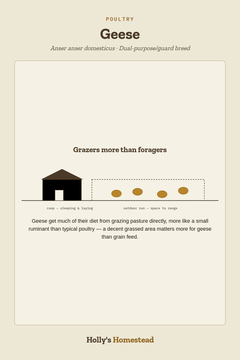
Grass is most of a goose’s diet. A UK guide suggests a quarter of an acre of grass suits a pair, and our Goose Housing Planner uses about 2.8 m² of pasture per goose as a minimum, which only works if you rotate them and supplement with grain. In dry summers and in arid zones, pasture dies back and geese need extra feed and water. Geese will weed between orchard trees and in vineyards, but they can damage young plants, so protect seedlings and young trees. See rotational grazing.
Housing, water and predators
A pair needs about 2.2 m² of shed (a 6 by 4 foot shed), and four or five geese about 4.3 m², in a UK beginner guide that matches our planner’s roughly 0.9–1 m² per goose. The shed should be dry, well ventilated and fox-proof, and geese are shut in at night. Geese do not need a pond: a tub deep enough to submerge their heads is sufficient, though they enjoy wading. Because of bird flu, an enclosed tub is safer than a pond wild birds use. In Australia, foxes, dogs and raptors threaten goslings, so use predator-proof fencing and cover. The Goose Housing Planner sizes the shed, pasture and cost.
Breeds, behaviour and noise
Chinese geese are lightweight and the noisiest of the common breeds. Embden and Toulouse are heavy breeds commonly kept for meat. The Australian Settler goose was developed for Australian conditions, can live over 20 years, and is noisy and needs plenty of fresh water in summer. Purebred numbers are declining. Geese are the noisiest poultry, and a gander in breeding season can disturb neighbours, so think carefully about your boundaries. Aggression is more common than in ducks or chickens, and handling goslings gently from young helps.
Most geese lay seasonally, often only a few dozen eggs a year. Our Goose Cost & Payback Calculator assumes 20–50 eggs a season and a meat price of about $45/kg, both unsourced estimates, so adjust them. Eggs take 29 days to hatch: use the Incubation Day-by-Day Planner.
Feed, health and care
Grass and clover supply most of the diet in the growing season, with wheat or layer pellets and grit in winter, in the dry and during laying. Goslings need a starter feed. Keep water clean and wash feeders. Quarantine new birds for 30 days, watch for worms and leg problems, and ask a vet about any sudden deaths, since bird flu is notifiable. Geese are long-lived, so plan for old age and rehoming. Calculate feed with the Livestock Feed & Hay Budgeter.
How geese change with your climate zone
Geese need grass and water, so rainfall pattern matters more than temperature. Set your zone to see what applies to you.
Tropical
Wet-season grass is abundant, but parasites and mosquito-breeding water increase. Wet-season humidity is hard on goslings.
Subtropical
Summer heat and noise near neighbours are the main issues, and many councils limit geese to large lots.
Warm Temperate
Workable on a large block with rotated pasture and shade; check council limits before you buy.
Mediterranean
Dry-summer pasture dies back, so grain and water matter more. Winter pasture growth is strong.
Cool Temperate
The best fit: geese are very cold-hardy, though the grass season is shorter so winter grain is needed.
Arid
Pasture is not sustainable without irrigation, so geese are a poor match.
Not sure of your zone? Use Find My Climate Zone.
Watch and learn
Video transcript
Intro: Holly's Homestead.
Title card: Geese — difficulty: Easy–moderate.
Quick reference: Space: 1m² shelter, large grazing area; Diet: Mostly grass/pasture + grain supplement; Water: Constant access, bathing water appreciated; Temperament: Alert, can be territorial; Lifespan: 15–20+ years.
Housing & setup: Shelter: Simple, weatherproof shelter; geese are very cold-hardy.
Daily care: Provide access to good grazing pasture as the main feed source.
Health & problems: Aggression toward people — more common than in ducks or chickens; regular handling helps.
Production & harvest: Yield: Meat birds typically processed at 10–20 weeks depending on breed and size target.
Outro: free printable A4 guide at hollyshomestead.com.au.
Every guide, tool and rule page for geese
Everything on this site that applies to geese, in one place.
Animal guides
How-to guides
Rules and costs
- Backyard livestock rules by state
- Best states for backyard livestock
- Council permits and livestock fees
- Queensland council livestock rules
- NSW council livestock rules
- Victoria council livestock rules
- South Australia council livestock rules
- Western Australia council livestock rules
- Tasmania council livestock rules
- NT council livestock rules
Related reading
- Bird flu and backyard poultry
- Chickens vs ducks vs quail
- Keeping ducks: the complete guide
- How much land do you need?
Words worth knowing
Frequently Asked Questions
Are geese noisy?
Yes. Geese are the noisiest poultry. Chinese geese are described as especially vocal, and any gander can disturb neighbours in breeding season. Consider your neighbours before you buy.
Do geese need a pond?
No. A tub deep enough to submerge their heads is sufficient. While H5N1 is circulating, an enclosed tub is safer than a pond that wild birds use.
How much land do geese need?
A UK guide suggests a quarter of an acre of grass for a pair. Our planner uses about 2.8 m² of pasture per goose as a minimum with rotation and grain, so more land is better.
Are geese allowed in suburban areas?
Often not. Moreton Bay allows no geese on blocks under 20,000 m². Check your council with My Council in One Place.
How long do geese live?
Around 20 years, and the Australian Settler can live over 20. This is a long commitment.
Are geese aggressive?
They can be, especially ganders in breeding season. Gentle, regular handling from a young age helps.
Sources: PoultryKeeper: beginner’s guide to keeping geese (UK) · Pip Magazine: Australian Settler geese · Moreton Bay Council poultry fact sheet · Alice Springs Council: keeping birds · Agriculture Victoria: H5 housing order