
Keeping Ducks in Australia: The Complete Guide
Ducks are tough, productive and good for slugs, but they are the poultry most affected by two things beginners overlook: council limits (many councils allow far fewer ducks than chickens) and H5N1 bird flu, because ducks can carry it without looking sick. Keep at least two, give them a tub or shallow pool to wash their heads in, not a pond, and cover the run.
 Printable one-page guide
Set your climate zone and this page will show what to do with ducks where you live, what to watch for right now, and the rules for your state. It stays on this device. Find my climate zone
Are ducks right for you?
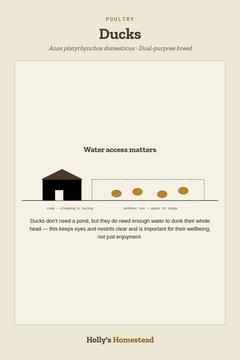
Ducks suit people who want eggs, slug control and a bird that copes well with wet weather. They are hardy, tend to be less prone to some chicken diseases, and a good laying breed can out-lay a chicken. The trade-offs are mess, noise and water. Ducks splash, so their area turns to mud, and ducks need water deep enough to dunk their heads. Females quack loudly, and drakes make a quieter rasp.
Keep at least two: ducks are flock animals and are unhappy alone. If you are choosing between ducks, chickens and quail, read Chickens vs Ducks vs Quail first, and compare with the complete chicken guide.
Check the rules first: councils, states and bird flu
Councils are often stricter on ducks than on chickens. In Moreton Bay (Qld), for example, a block under 3,000 m² may keep no ducks at all, 3,001–10,000 m² may keep ten and larger blocks twenty. Mitcham council in South Australia counts ducks and geese as poultry for its rules. Alice Springs allows them without a permit but expects ponds to be cleaned at least every second day. Find your council with My Council in One Place, then read the rules for your state.
| State | What to check | Rules tool |
|---|---|---|
| NSW | PIC needed at 100 or more birds (NSW DPI); NSW Food Authority licensing or notification applies to egg and meat sellers; council sets numbers and noise rules | Council rules |
| Victoria | PIC at 50 or more poultry (free); egg stamping with your PIC at 50 or more; H5 housing order in listed southern and coastal council areas for flocks of 50+ | Council rules |
| Queensland | Biosecurity entity registration at 100 or more birds; avian influenza must be reported; council limits depend on block size | Council rules |
| South Australia | Council sets limits (Mitcham counts ducks and geese as poultry); enclose runs because of wild-bird H5N1 activity | Council rules |
| Western Australia | Registration at 50 or more poultry; some species (such as Japanese quail) need a permit; council sets numbers | Council rules |
| Tasmania | Council rules; egg sellers should follow council food safety guidance (clean, stamped eggs in new cartons) | Council rules |
| Northern Territory | Every property with poultry needs a PIC (free); Alice Springs has no numerical limit or permit | Council rules |
| ACT | Not verified here: see the state-by-state rules article | State rules |
Checked 7 October 2026 from state department pages. Poultry registration rules cover ducks too. Thresholds change, so confirm with your department. See our state-by-state livestock rules.
Bird flu matters more for ducks. H5N1 (clade 2.3.4.4b) reached wild birds on the Australian mainland in June 2026. Ducks, geese and swans are the main wild-to-domestic risk group, and domestic ducks can carry the virus without looking sick and pass it to chickens. Official backyard advice is to keep poultry away from wild birds and their droppings, keep ducks off ponds and dams that wild birds use (offer an enclosed tub or pond instead), cover the run and cover feed and water. Victoria has ordered flocks of 50 or more birds in many southern and coastal council areas to be housed, and other states have issued advice. Report sick or dead birds on the Emergency Animal Disease Watch Hotline, 1800 675 888. See our bird flu article and the Agriculture Victoria order page.
Water: what ducks actually need
Ducks need water to drink deeply (they clear their nostrils with it) and to keep their eyes and feathers in condition, but they do not need a pond. RSPCA guidance is a shallow water container about 10–20 cm deep for dabbling, with deeper water only if you want them to swim. A clam shell paddling pool or a stock tub with a ramp is enough for a small flock. Empty and refresh it daily in summer: stagnant water breeds mosquitoes and disease. Put the tub on a drained, gravelled or sloping area so the mud does not spread, and shade it.
If you have a dam or pond, remember the bird flu advice above: wild waterbirds use it too, so a covered, enclosed tub is the safer choice while H5N1 is circulating.
Housing and predators
Ducks need a dry, ventilated, fox-proof house they are shut into every night, with 10–15 cm of deep litter that you top up often because ducks are messy. RSPCA guidance is at least 1 m² of shelter for every one or two ducks and a comfortable temperature range of about 7–23°C, with 10–15°C ideal. Our Duck Housing Planner works from a smaller minimum (about 0.4 m² of house and 1.4 m² of run per duck), so treat our figures as the least you can get away with and add room if you can. Heavy breeds do not fly far, but lighter layers such as Khaki Campbells and Runners can, so the run needs a roof for foxes, raptors and, now, wild birds.
Use our coop how-to as a starting point (use solid walls and a floor that drains, and a ramp rather than steps) and the fencing basics guide for the run.
Breeds, eggs and noise
Choose by purpose. Pekin ducks are a heavy meat bird (about 3.5–4 kg) with fewer eggs; our own calculator assumes 140–200 eggs a year for dual-purpose birds like these. Khaki Campbell is the classic laying duck (about 2.25–2.5 kg), averaging up to about 300 eggs a year according to Poultry Hub Australia. Cayuga is a good layer and is described as quieter. Muscovy ducks are docile, quiet and eat snails. Indian Runners are upright layers and very active.
Duck eggs are larger than chicken eggs and are popular for baking. Rules for selling eggs match chicken eggs, so see the egg section of our chicken guide. If you want to hatch ducklings, ducks take 28 days: use the Incubation Day-by-Day Planner.
Feed
Ducklings need a starter feed for the first two weeks and a grower feed until about eight weeks, then a breeder or layer ration with more calcium for laying females (RSPCA). Chicken feed is a common substitute, but ducks have different niacin needs, so use a duck feed or supplement where you can and avoid heavily medicated chicken starter unless a vet advises it. Treats should be less than 10% of the diet. Ducks need water beside their feed because they wash food down as they eat. Work out quantities with the Livestock Feed & Hay Budgeter.
Health and keeping them well
Healthy ducks are alert, preen often and have clear nostrils and bright eyes. Keep ground well drained to prevent bumblefoot, wash and refresh water, and quarantine new birds for 30 days. Worm regularly and check for lice and mites. In hot weather ducks suffer heat stress above their 7–23°C comfort range, so provide shade and water they can submerge their bills and heads in. Because ducks can carry avian influenza silently, never let them mix with wild waterbirds, and ask a vet about any unusual deaths or neurological signs. Ask your vet about medications, because withholding periods apply to eggs and meat.
What it costs
Ducks are cheap to start and cost slightly more than chickens to feed per bird because of the extra water and mess. Use the Backyard Duck Cost & Payback Calculator with your own prices for birds, feed and housing, and compare the result with chickens.
How ducks change with your climate zone
Ducks handle wet and cold well, so heat and water hygiene are the main climate issues. Set your zone to see what applies to you.
Tropical
The wet season suits ducks, but mud, bumblefoot and mosquito-breeding water need constant management. Keep water fresh and the run drained.
Subtropical
Summer heat and humidity push ducks above their comfortable range. Shade, fresh water to submerge in, and a drained run help most.
Warm Temperate
Mostly easy: provide shade and water in summer, and keep the shelter dry in winter.
Mediterranean
Dry summers make a mud-free water area easier, but shade and water refills matter. Check H5 advice in SA, WA and Victoria.
Cool Temperate
Ducks tolerate cold and wet well, so this is their best zone. Keep bedding dry and check for frozen water.
Arid
Heat is the limit. A shaded, frequently refilled bath is a welfare need, not a luxury.
Not sure of your zone? Use Find My Climate Zone.
Watch and learn
Video transcript
Intro: Holly's Homestead.
Title card: Ducks — difficulty: Easy.
Quick reference: Space: 0.4m² shelter, 2–4m² run with water access; Diet: Waterfowl or poultry pellets + foraged slugs/greens; Water: Constant access, plus a tub for dabbling; Temperament: Calm, hardy, good foragers; Lifespan: 8–12 years.
Housing & setup: Shelter: Simple, draft-free shelter; ducks are hardier in wet weather than chickens.
Daily care: Provide a tub or shallow pond deep enough to submerge the head.
Health & problems: Muddy, fouled housing — manage water areas to avoid a permanent bog.
Production & harvest: Yield: Up to 300+ eggs a year in good dual-purpose laying breeds.
Outro: free printable A4 guide at hollyshomestead.com.au.
Video transcript
Intro: Holly's Homestead.
Title card: Building a Chicken Coop — difficulty: Moderate.
Quick reference: Difficulty: Moderate; Time: 1–7 days; Cost: Moderate–high; Best Season: Before bringing home birds; Frequency: Built once, maintained ongoing.
What you'll need: Timber or another frame material
Method: 1. Plan for roughly 0.3–0.4m² of coop space per bird, plus an attached or separate run.
Troubleshooting: Predator getting in despite precautions — check every gap and latch carefully; predators exploit surprisingly small weaknesses.
Timing & maintenance: Best time: Build before bringing home birds, allowing time to get the design right without pressure.
Outro: free printable A4 guide at hollyshomestead.com.au.
Every guide, tool and rule page for ducks
Everything on this site that applies to ducks, in one place.
Animal guides
How-to guides
Rules and costs
- Backyard livestock rules by state
- Best states for backyard livestock
- Council permits and livestock fees
- Queensland council livestock rules
- NSW council livestock rules
- Victoria council livestock rules
- South Australia council livestock rules
- Western Australia council livestock rules
- Tasmania council livestock rules
- NT council livestock rules
Related reading
- Bird flu and backyard poultry
- Chickens vs ducks vs quail
- Keeping chickens: the complete guide
- Keeping geese: the complete guide
Words worth knowing
Frequently Asked Questions
Do ducks need a pond?
No. Ducks need water deep enough to dunk their heads, such as a stock tub or shallow pool, ideally 10–20 cm deep for dabbling. Refresh it daily in summer. While bird flu is circulating, an enclosed tub is safer than a pond wild birds use.
Are ducks noisy?
Female ducks quack loudly, while drakes rasp more quietly. Muscovy ducks are generally quiet and Cayuga are described as quieter. Check council noise rules.
How many ducks can I keep in my backyard?
It depends on your council, and limits are often lower than for chickens. Moreton Bay allows none under 3,000 m², ten on 3,001–10,000 m² and twenty on larger blocks. Check yours with My Council in One Place.
Can ducks live with chickens?
They can, but ducks make wet, muddy bedding that chickens dislike, and ducks can carry avian influenza without symptoms. During the current H5N1 situation, keeping them separate is safer.
How many eggs does a duck lay?
Khaki Campbells can average up to about 300 eggs a year, while heavier dual-purpose breeds like Pekin lay fewer, commonly 140–200.
Are ducks at risk from bird flu?
Yes. Ducks, geese and swans are the main wild-to-domestic risk group, and domestic ducks can carry H5N1 without looking sick. Cover the run, keep them off wild-bird ponds and report sick or dead birds on 1800 675 888.
Sources: RSPCA: caring for pet ducks · Poultry Hub Australia: Khaki Campbell · Burke’s Backyard: keeping ducks · Moreton Bay Council poultry fact sheet · Alice Springs Council: keeping birds · Agriculture Victoria: H5 housing order