
Planning a Whole Homestead: A Huon Valley Family and an AI Assistant
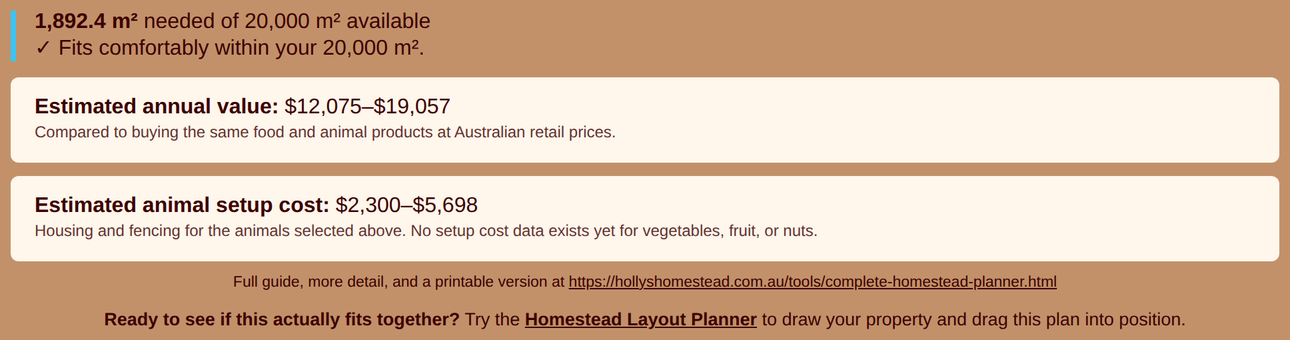
A worked example of the Complete Homestead Planner and an AI assistant working together: an invented family of four in Tasmania’s Huon Valley describes what they want from a five-acre block, and the AI turns it into a 25-item plan that needs 1,892 m² of the 20,000 m² (about 9%) and is worth an estimated $12,075–$19,057 a year at retail prices. The screens below are the real tool.
At a glance
- Tool: Complete Homestead Planner
- Scenario: a family of four planning vegetables, fruit, nuts, eggs, meat and honey on five acres
- Climate zone: Cool Temperate (Huon Valley, Tasmania)
- Handoff method: a downloadable file (the link would run to about 2,450 characters, past the roughly 2,000 that links handle reliably)
- Result: 1,892.4 m² needed of 20,000 m²; $12,075–$19,057 a year; $2,300–$5,698 to set up the animals
The situation
Imagine a family of four who have bought five acres in the Huon Valley, south of Hobart. They want the land to feed them, but they don’t know what that means in practice: how much of the block does a year of vegetables take, how many apple trees is “enough”, how many hens, and would a couple of sheep use up half the property?
The Complete Homestead Planner answers that across the whole homestead at once. You tick what you want to grow or keep, say how often and how much each person eats, and it works out the space, the number of plants or animals, an annual retail value and the setup cost of the animals. The AI’s job is to choose sensible items for a cool, wet climate and fill in realistic quantities, which is the part most people find hardest.
What they tell the AI
No technical knowledge is needed. This is everything the person supplies:
- A family of four on five acres (about 20,000 m²) in the Huon Valley, Tasmania.
- What they want: lots of vegetables; apples, pears, plums and berries; some nuts; their own eggs; chickens and lamb for the freezer; honey.
- What they don’t want: dairy.
The prompt
Every handoff tool on this site has a Copy AI Prompt button that puts a ready-made instruction on your clipboard. They paste it into their AI assistant and fill in the bracketed part:
This is the broadest of the handoff tools, so the description can be loose. The AI works out the detail.
What the AI does, step by step
- Reads the tool page. It finds the embedded format block and learns the rules that are easy to get wrong: land area is in square metres, category names are the seven shown on the page (Vegetables, Fruit, Nuts, Eggs, Milk, Meat and Honey), and when a plan lists items, anything not listed is switched off.
- Chooses categories. Vegetables, Fruit, Nuts, Eggs, Meat and Honey. It leaves out Milk because the family said no dairy.
- Chooses items for a cool climate. Brassicas and roots such as cabbage, broccoli, cauliflower, kale, carrot, parsnip and beetroot, plus leeks, onions, garlic and peas; apples, pears, plums, blueberries and raspberries; walnuts and hazelnuts. It skips frost-tender warm-climate crops such as okra or mango.
- Sets how often and how much. Each item has a frequency per week and a quantity per person each time, for example one carrot three times a week, or 150 g of pears three times a week. The tool multiplies this by four people, 52 weeks and a 20% buffer, so one carrot three times a week for four people becomes 749 carrots a year.
- Keeps the plan realistic. It uses small quantities for bulky items (a quarter of a cabbage, 20 g of walnuts) so that the plan is a believable supplement rather than every serving of every meal.
- Chooses a file. Twenty-five items make a link of about 2,450 characters, so the AI hands back a file.
What the AI hands back
A .json file (a .txt with the same content works too). The person opens the Complete Homestead Planner and uses Import a Saved File, then picks the plan from the Saved plans dropdown and presses Load. Here is the file in full:
{
  "slots": {
    "Huon Valley five acres": {
      "household": "4",
      "landArea": "20000",
      "categories": [
        "Vegetables",
        "Fruit",
        "Nuts",
        "Eggs",
        "Meat",
        "Honey"
      ],
      "items": [
        {
          "id": "carrot",
          "checked": true,
          "freq": 3,
          "qty": 1
        },
        {
          "id": "onion",
          "checked": true,
          "freq": 3,
          "qty": 1
        },
        {
          "id": "garlic",
          "checked": true,
          "freq": 1,
          "qty": 0.5
        },
        {
          "id": "cabbage",
          "checked": true,
          "freq": 2,
          "qty": 0.25
        },
        {
          "id": "broccoli",
          "checked": true,
          "freq": 2,
          "qty": 0.25
        },
        {
          "id": "cauliflower",
          "checked": true,
          "freq": 1,
          "qty": 0.25
        },
        {
          "id": "kale",
          "checked": true,
          "freq": 1,
          "qty": 0.5
        },
        {
          "id": "leek",
          "checked": true,
          "freq": 1,
          "qty": 1
        },
        {
          "id": "beetroot",
          "checked": true,
          "freq": 1,
          "qty": 1
        },
        {
          "id": "parsnip",
          "checked": true,
          "freq": 1,
          "qty": 1
        },
        {
          "id": "silverbeet",
          "checked": true,
          "freq": 2,
          "qty": 0.5
        },
        {
          "id": "spinach",
          "checked": true,
          "freq": 1,
          "qty": 0.5
        },
        {
          "id": "lettuce",
          "checked": true,
          "freq": 3,
          "qty": 0.5
        },
        {
          "id": "peas",
          "checked": true,
          "freq": 2,
          "qty": 1
        },
        {
          "id": "apple",
          "checked": true,
          "freq": 4,
          "qty": 1
        },
        {
          "id": "pear",
          "checked": true,
          "freq": 3,
          "qty": 0.15
        },
        {
          "id": "plum",
          "checked": true,
          "freq": 3,
          "qty": 0.15
        },
        {
          "id": "raspberry",
          "checked": true,
          "freq": 2,
          "qty": 0.1
        },
        {
          "id": "blueberry",
          "checked": true,
          "freq": 2,
          "qty": 0.1
        },
        {
          "id": "walnut",
          "checked": true,
          "freq": 3,
          "qty": 0.02
        },
        {
          "id": "hazelnut",
          "checked": true,
          "freq": 3,
          "qty": 0.02
        },
        {
          "id": "eggs",
          "checked": true,
          "freq": 4,
          "qty": 2
        },
        {
          "id": "meat-chicken",
          "checked": true,
          "freq": 1,
          "qty": 0.25
        },
        {
          "id": "lamb",
          "checked": true,
          "freq": 1,
          "qty": 0.1
        },
        {
          "id": "honey",
          "checked": true,
          "freq": 7,
          "qty": 0.02
        }
      ],
      "savedAt": "2026-10-05T00:00:00.000Z"
    }
  }
}
The result
First the summary, which is the real tool’s output after loading the plan:
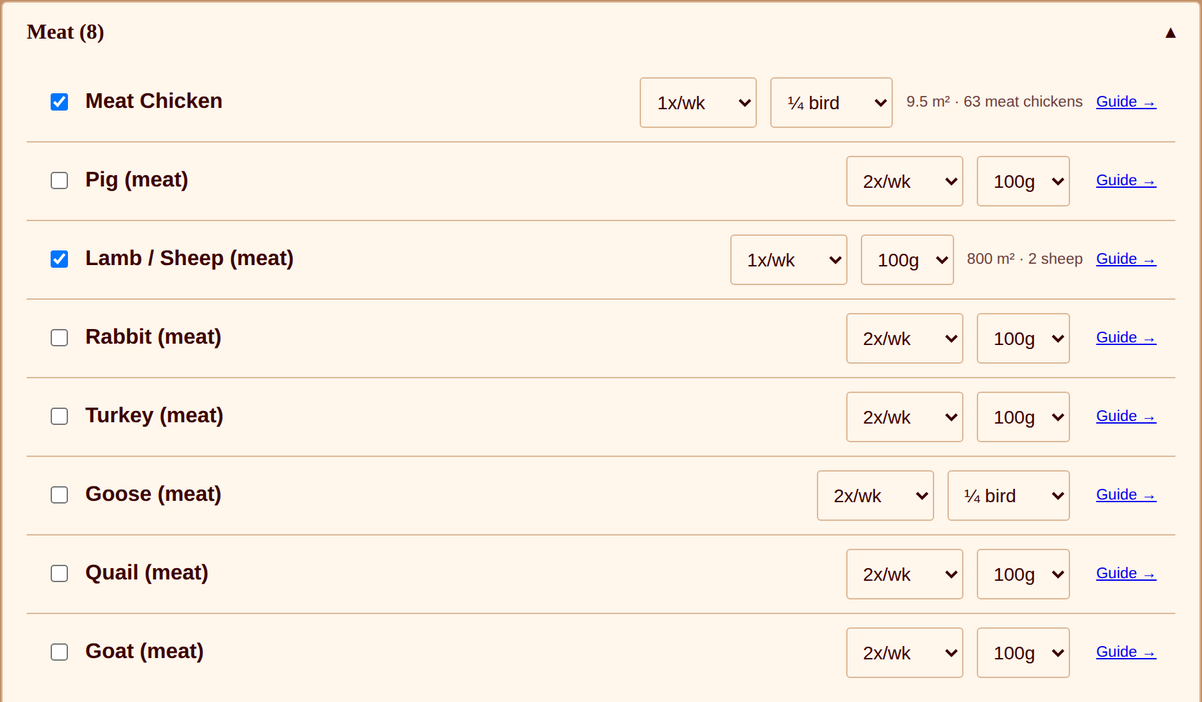
The plan is a checklist, with one category open at a time. Here is Meat. Only meat chicken and lamb are ticked, and everything else in the category has been switched off:
All 25 items, as the tool shows them:
| Category | Item | Each person, each time | Space | Plants or animals |
|---|---|---|---|---|
| Vegetables | Carrot | 1 carrot, 3× a week | 11.5 m² | 749 carrots |
| Vegetables | Onion | 1 onion, 3× a week | 18.7 m² | 749 onions |
| Vegetables | Garlic | ½ bulb, 1× a week | 5 m² | 125 bulbs |
| Vegetables | Cabbage | ¼ head, 2× a week | 25 m² | 125 heads |
| Vegetables | Broccoli | ¼ head, 2× a week | 25 m² | 125 heads |
| Vegetables | Cauliflower | ¼ head, 1× a week | 15.6 m² | 62 heads |
| Vegetables | Kale | ½ bunch, 1× a week | 31.2 m² | 125 bunches |
| Vegetables | Leek | 1 leek, 1× a week | 16.6 m² | 250 leeks |
| Vegetables | Beetroot | 1 beetroot, 1× a week | 10 m² | 250 beetroots |
| Vegetables | Parsnip | 1 parsnip, 1× a week | 12.5 m² | 250 parsnips |
| Vegetables | Silverbeet | ½ bunch, 2× a week | 49.9 m² | 250 bunches |
| Vegetables | Spinach | ½ bunch, 1× a week | 6.2 m² | 125 bunches |
| Vegetables | Lettuce | ½ head, 3× a week | 23.4 m² | 374 heads |
| Vegetables | Peas | 1 serve, 2× a week | 41.6 m² | 499 serves |
| Fruit | Apple | 1 apple, 4× a week | 141.8 m² | 7 trees |
| Fruit | Pear | 150 g, 3× a week | 150 m² | 6 trees |
| Fruit | Plum | 150 g, 3× a week | 162 m² | 8 trees |
| Fruit | Raspberry | 100 g, 2× a week | 13.8 m² | 50 canes |
| Fruit | Blueberry | 100 g, 2× a week | 23.4 m² | 15 bushes |
| Nuts | Walnut | 20 g, 3× a week | 156.3 m² | 1 tree |
| Nuts | Hazelnut | 20 g, 3× a week | 101.3 m² | 5 bushes |
| Eggs | Eggs | 2 eggs, 4× a week | 23.5 m² | 10 laying hens |
| Meat | Meat chicken | ¼ bird, 1× a week | 9.5 m² | 63 meat chickens |
| Meat | Lamb | 100 g, 1× a week | 800 m² | 2 sheep |
| Honey | Honey | 20 g, daily | 18.8 m² | 3 hives |
The rows are rounded individually, so they add up to a fraction more than the tool’s own total of 1,892.4 m².
What the numbers mean
1,892 m² is about 9% of the block. The family can do all of this and still have more than 18,000 m² free, which is room for paddocks, buildings, a larger garden or simply bush.
Most of the space is trees and sheep, not vegetables. The two sheep (800 m²) and the apple, pear, plum, walnut and hazelnut trees together take about 1,511 m², around 80% of the total. All fourteen vegetables together need only 292 m².
Where the value comes from. The tool values vegetables at about $4,200–$6,700 a year, fruit at $3,600–$6,100, meat at $1,700–$2,500, honey at $960–$1,440, eggs at $990–$1,440 and nuts at $620–$950. Compact, high-priced items such as raspberries, blueberries, honey and eggs earn well for the space they use.
The setup cost covers animals only. The $2,300–$5,698 is housing and fencing for the hens, meat chickens, sheep and bees. The tool has no setup figures for vegetables, fruit or nuts; for those, use the Setup Cost Estimator.
Follow-up prompts worth trying
The first answer is rarely the last. The same conversation can keep refining the plan:
- “Add a dairy goat and tell me how much more land that needs.” — the AI adds the Milk category and re-runs the plan.
- “We only have a quarter of an acre. Shrink this to fit.” — the AI drops the sheep and trees first, since they use the most space.
- “Which of these will take longest to start producing?” — fruit and nut trees take years to reach full yield, while most vegetables take months.
- “Now place all of this on the block.” — hand the plan on to the Homestead Layout Planner; see the Alice Springs layout example.
- “What does the whole plan cost to set up?” — see the Brisbane setup cost example.
What to check yourself
An AI is quick at turning a description into a filled-in tool, which is why this works. It is not a substitute for checks only you can do:
- Trees take years. The figures assume mature trees and full production. In the first years of an orchard, harvests will be a fraction of what the tool shows.
- Check the plan has no extra items. The tool switches off anything the file doesn’t list. If you see ticked items you didn’t ask for, the file didn’t load as intended.
- The value is a retail comparison, not income. It is what the same food would cost at Australian retail prices, and it is a planning estimate, not a promise. Real yields and prices vary.
- Council rules decide the animals. Sheep, meat chickens and bees are all regulated locally. Check Tasmanian livestock rules by council before buying animals, and confirm with your own council.
- Climate decides the crops. The Tasmania environmental conditions page has frost and rainfall data for your region.
- Check the quantities against your household. One serving of one vegetable multiplied across a year adds up quickly, so check that the amounts match what you really eat.
Doing this in a different climate?
The tool does the same arithmetic everywhere, but the right items and the space they need change with climate. Tell your AI your postcode or climate zone:
- Tropical and Subtropical (Darwin, Brisbane): bananas, mangoes, pawpaw, okra, sweet potato and snake beans, with year-round vegetables and little or no walnut or apple.
- Warm Temperate (Sydney): a mix of both, with citrus, stone fruit and most vegetables.
- Mediterranean (Perth, Adelaide): olives, almonds, citrus and figs, with heavier watering needs in summer.
- Cool Temperate (Hobart, Melbourne, Canberra): apples, pears, plums, berries and nuts, with brassicas and roots, as in this example.
- Arid (Alice Springs): far fewer items, with water and shade as the real limits, and a much larger area for the same food.
More examples, across other tools and climate zones, are on the AI Examples page.