
Does It Fit? Planning a Perth Hills One-Acre Block With an AI Assistant
A worked example of the Homestead Block Planner and an AI assistant working together: an invented family of four on a one-acre Perth Hills block lists everything they dream of growing and keeping, and the AI checks it against the land. The answer is that it needs 1,136.5 m² of 4,000 m² (28%), so it fits, and a follow-up shows exactly what happens when they ask for too much. Every number is read off the real tool.
At a glance
- Tool: Homestead Block Planner
- Scenario: one-acre block, family of four, mixed orchard plus animals
- Climate zone: Mediterranean (Perth and the Perth Hills)
- Handoff method: a direct link (about 811 characters, inside the ~2,000 limit)
- Result: 1,136.5 m² of 4,000 m² used (28%), fits
The situation
Imagine a family of four who have just bought a one-acre block in the Perth Hills: 50 metres wide and 80 metres long. They have a list as long as their arm. Vegetables for the whole family, an orchard, hens, ducks, bees, two dairy goats. What they don’t know is whether it all fits, and whether there’s room left for the house, the shed and everything else that isn’t food.
That is the question the Homestead Block Planner answers. It knows how much ground each crop and animal in the site’s guides needs, adds up what you choose, and compares it with your block. It also has a button that fills in the staple vegetables for your household size, so the AI doesn’t have to guess at quantities for the basics.
What they tell the AI
No technical knowledge is needed. This is everything the person supplies:
- Their block: a one-acre Perth Hills block, 50 m wide by 80 m long.
- The household: four people.
- Food crops: the staple vegetables for four people.
- A small mixed orchard: olives, almonds, figs, stone and pome fruit, citrus and grapes.
- Animals: six hens, four ducks, two beehives and two dairy goats.
- The question: does it all fit, and what isn’t counted?
The prompt
Every handoff tool on this site has a Copy AI Prompt button that puts a ready-made instruction on your clipboard. They paste it into their AI assistant and fill in the bracketed part:
The bracketed part is where their description goes. Asking “what it leaves out” is the person’s own addition, and a useful one, because the planner only counts growing and keeping space.
What the AI does, step by step
- Reads the tool page. It finds the embedded format block and learns that quantities go in as a
valuesobject keyed by the real input id of each crop or animal, alongside block width, length and household size. - Starts from the tool’s own staples. The planner has a built-in per-person list of staple vegetables. For four people that gives, for example, 60 potato plants, 60 onions, 40 garlic, 100 carrots and 16 tomatoes. The AI uses those rather than inventing figures.
- Adds the family’s own choices. Six olives, two each of almond, fig, apple, plum, orange and lemon, one mandarin and six grape vines; six hens, four ducks, two beehives and two dairy goats. The goats come in a pair because they’re herd animals and don’t do well alone.
- Gets the ids right. Each id is the page’s own
qty-plus the item name in lower case with dashes, for exampleqty-sweet-potatoandqty-dairy-goats. The tool ignores an id it doesn’t recognise without any error, so a wrong guess would silently drop that item from the total. - Builds the link. With 28 items the encoded link is about 811 characters, inside the roughly 2,000-character limit, so a link works. A file is the better choice if the plan grows.
- Says what is not counted. The planner counts the ground that crops and animals use, not the house, driveway, sheds, tanks, firebreaks or paths.
What the AI hands back
One link. Opening it fills in the block size, household and every quantity, and the tool calculates straight away. Nothing is uploaded and no account is involved.
Open this exact plan in the Block Planner →
For a copy to keep, the AI would instead produce this file. Save it with a .json extension (a .txt with the same content also works) and use the tool’s Import a Saved File button:
{
  "slots": {
    "Perth Hills one-acre plan": {
      "width": "50",
      "length": "80",
      "areaOverride": "",
      "people": "4",
      "values": {
        "qty-potato": 60,
        "qty-sweet-potato": 20,
        "qty-onion": 60,
        "qty-garlic": 40,
        "qty-carrot": 100,
        "qty-tomato": 16,
        "qty-pumpkin": 8,
        "qty-zucchini": 8,
        "qty-broad-beans": 48,
        "qty-peas": 60,
        "qty-cabbage": 16,
        "qty-silverbeet": 12,
        "qty-capsicum": 12,
        "qty-cucumber": 12,
        "qty-corn": 48,
        "qty-olive": 6,
        "qty-fig": 2,
        "qty-orange": 2,
        "qty-mandarin": 1,
        "qty-lemon": 2,
        "qty-plum": 2,
        "qty-almond": 2,
        "qty-apple": 2,
        "qty-grape": 6,
        "qty-laying-hens": 6,
        "qty-ducks": 4,
        "qty-honeybees": 2,
        "qty-dairy-goats": 2
      },
      "savedAt": "2026-10-05T00:00:00.000Z"
    }
  }
}
The result
This is the real tool after loading that link: the block size and household at the top, and the summary with its category bars underneath.
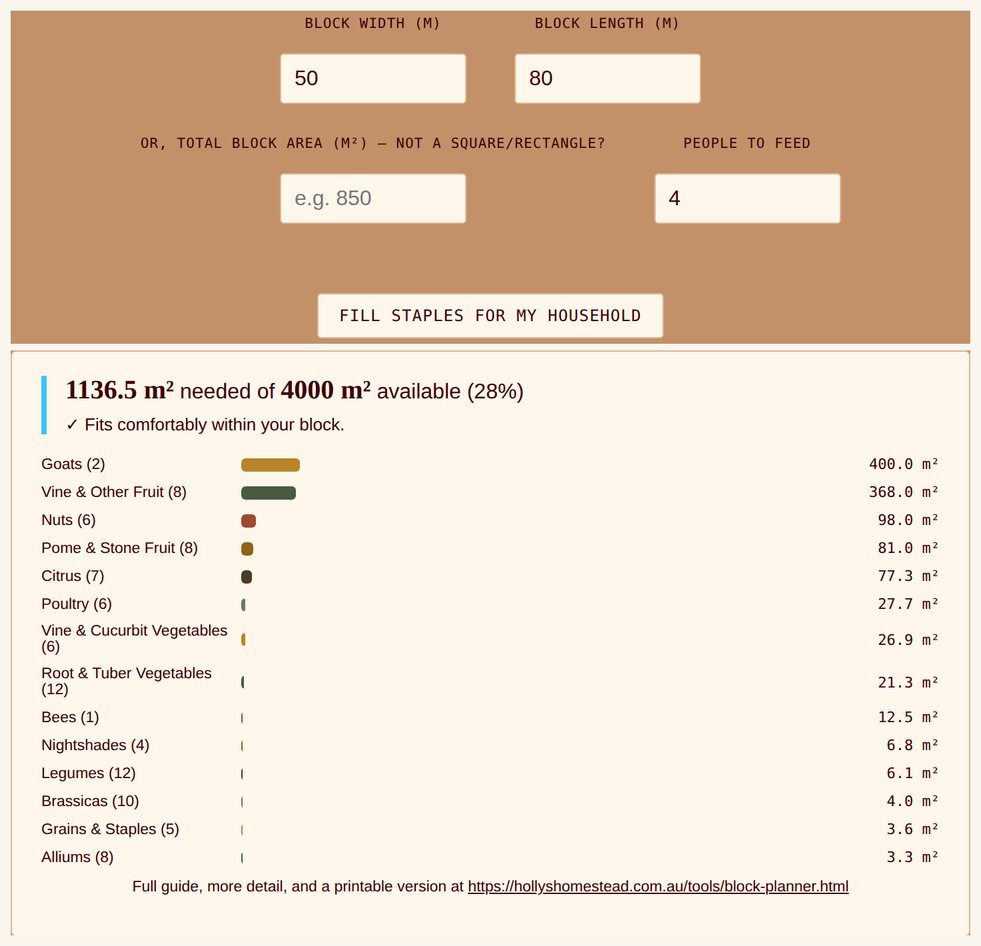
| Item | Qty | Area (m²) | Note |
|---|---|---|---|
| Dairy goats | 2 | 400.0 | Two, because goats shouldn’t be kept alone |
| Olive | 6 | 294.0 | Six trees; the biggest tree item |
| Almond | 2 | 98.0 | Two trees |
| Fig | 2 | 50.0 | Two trees |
| Apple | 2 | 40.5 | Two trees |
| Plum | 2 | 40.5 | Two trees |
| Orange | 2 | 40.5 | Two trees |
| Lemon | 2 | 24.5 | Two trees |
| Mandarin | 1 | 12.2 | One tree |
| Grape | 6 | 24.0 | Six vines |
| Laying hens | 6 | 14.1 | Six birds |
| Ducks | 4 | 13.6 | Four birds |
| Honeybees | 2 | 12.5 | Two hives |
| 15 staple vegetables | — | 72.0 | Potato, onion, garlic, carrot, tomato, pumpkin, corn and the rest of the tool’s staple list, scaled for 4 people |
| Total | 1,136.5 | 28% of 4,000 m² |
What the numbers mean
It fits, with room to spare. 1,136.5 m² is 28% of the block, so 2,863.5 m² is left for the house, driveway, sheds, water tanks, access and the buffers a rural block needs. That’s a healthy margin, not an invitation to fill it.
Two items take most of the space. The two goats use 400 m² and the orchard trees and vines about 600 m² between them (olives alone are 294 m²). All 15 staple vegetables together use only about 72 m². It’s a surprise to many people: feeding a family of four their staple vegetables takes far less ground than a single tree crop does, which is why the planner shows the categories side by side.
Then they push it. The family asks the AI: “What if we also wanted a house cow?” The AI adds one dairy cow to the same plan and sends a new link. This is the real result:
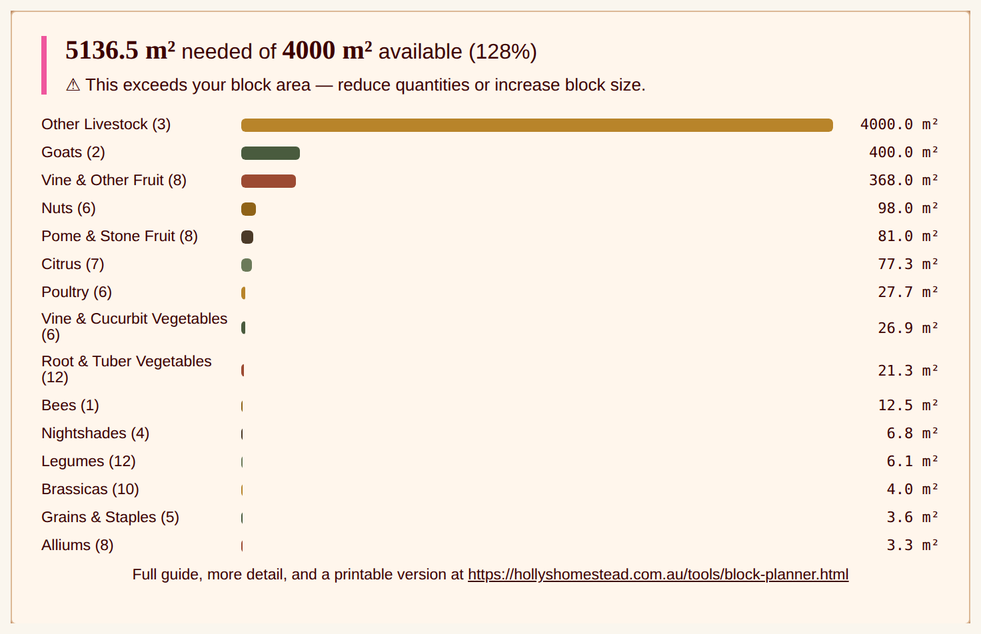
The cow alone is allocated 4,000 m², the whole block, so the plan jumps to 128% and the tool shows a warning. Without the planner the family might have found this out after buying the cow. Open the overflow version to see it for yourself.
Follow-up prompts worth trying
The first answer is rarely the last. The same conversation can keep refining the plan:
- “What would I have to cut to fit a second beehive and ten more fruit trees, and still stay under 40%?” — the AI adjusts quantities and you compare the new percentage.
- “Now lay out where everything should go on the block.” — that’s the job of the Homestead Layout Planner, which an AI can also fill in.
- “What would all of this cost to set up?” — the Setup Cost Estimator takes the same kind of handoff.
What to check yourself
An AI is quick at turning a description into a filled-in tool, which is why this works. It is not a substitute for checks only you can do:
- Check the item count. A wrongly spelled id is dropped without any error, so the total comes out too low. Compare the category bars with what you asked for: if the goats or the olives are missing, an id was wrong.
- The planner measures space, not suitability. It does not check that an olive, an almond or a goat is permitted or sensible on your particular block. Council rules for livestock numbers and setbacks vary, so start with the Western Australia council livestock rules and confirm with your own council.
- Bushfire. Much of the Perth Hills is mapped as bushfire prone, which can affect where buildings, tanks and plantings can go. The WA environmental conditions page links to the official hazard mapping; check your own lot.
- It leaves out the house and infrastructure. The 2,863.5 m² left over has to cover all of that, and the usable shape of a block matters as much as the area.
- Per-plant areas are typical, not exact. They are based on standard spacing. Your soil, variety and pruning will move them.
Doing this in a different climate?
The block size, the staples and the animal space apply anywhere in Australia. What changes with climate is which crops and animals you pick, and the quantities of the thirsty ones. Tell your AI your postcode or climate zone so it chooses suitably:
- Subtropical and Tropical (Brisbane, Cairns, Darwin): swap the olives and almonds for mango, avocado, banana or macadamia, though check the area each one claims in the tool, as some are very large trees.
- Cool Temperate (Hobart, Canberra, Melbourne): apples, pears, cherries and hazelnuts take the place of olives and citrus.
- Arid (Alice Springs): irrigation supply, not ground area, will usually be the limit, so the planner tells you what fits in space but not in water.
- Everywhere: animal numbers and setbacks are set by your council and state, whatever the climate.
More examples, across other tools and climate zones, are on the AI Examples page.