
Costing a Brisbane Backyard Homestead With an AI Assistant
A worked example of the Setup Cost Estimator and an AI assistant working together: a made-up household on a typical suburban Brisbane block describes what they want in plain English, the AI turns it into a ready-filled estimate, and the result is $2,550–$4,900. Every number below was read off the real tool, not invented for the page — and the page is just as clear about which parts of the AI's answer you still need to check yourself.
At a glance
- Tool: Setup Cost Estimator
- Scenario: small suburban backyard, first-year start-up
- Climate zone: Subtropical (Brisbane and South-East Queensland)
- Handoff method: a direct link (the plan is small enough to fit comfortably inside one)
- Result: $2,550–$4,900 for the full set-up
The situation
Imagine a couple with a standard Brisbane suburban block — roughly 600 square metres, a house, a lawn, and a sunny back corner they've never used. They want to start small: a handful of raised beds for vegetables, four laying hens for eggs, and some way of catching rainwater so the garden isn't running off the town supply all summer. They don't have a budget figure yet. They want to know whether this is a $500 weekend project or a $10,000 commitment before they spend a cent.
This household is invented for the example, but the question is a real one — it's the first thing most people ask. The Setup Cost Estimator has preset price ranges for common infrastructure (fencing, water tanks, coops, raised beds and animal housing), and it also lets you add your own items. The AI's job is to translate “what we want” into the right preset quantities, add anything the presets don't cover, and hand it over in a form the tool understands.
What the household tells the AI
No technical knowledge is needed. This is everything the couple supplies:
- They live in suburban Brisbane on roughly a 600 m² block.
- They want about six raised vegetable beds, each around 1.2 m × 1.2 m, to start with.
- They want four laying hens in a small coop with a fenced run, around 3 m × 3 m.
- They want a rainwater tank sized for a suburban garden.
- They're happy to do the building themselves, so DIY and kit prices are fine.
- They'd like to know what's not included in the number, not just the number.
The prompt
Every handoff tool on this site has a Copy AI Prompt button that puts a ready-made instruction on your clipboard. For the Setup Cost Estimator it asks the AI to use the format embedded on the page and not to invent fields. The couple paste it into their AI assistant of choice and fill in the bracketed part:
The last sentence is the couple's own addition, and it is worth copying. An estimate that lists what it leaves out is far more useful than one that sounds complete.
What the AI does, step by step
- Reads the tool page. It fetches the Setup Cost Estimator and finds the embedded format block, which lists the exact structure it must produce and warns that quantity keys must be the real input ids from the page rather than guessed names.
- Matches the request to real presets. It reads the page's price rows and picks the closest matches: Raised garden bed (6), Chicken coop — small, 2–5 birds (1), Chain wire / mesh fencing (12 metres), and Water tank — medium, about 5,000 L (1).
- Works out the quantities. A 3 m × 3 m run has a 12 m perimeter, so 12 metres of fencing. The medium tank is the size the tool itself describes as common for suburbs. Six beds and one coop come straight from the couple's own words.
- Spots what the presets don't cover. The tool's own note on raised beds says the price excludes soil, and there's no preset for irrigation or composting. The AI adds three custom items for those — this is the part where the AI is estimating prices itself rather than reading them from the tool.
- Builds the handoff. The plan is small, so it builds a direct link rather than a file. (If the couple wanted a saved copy to keep, it could equally write the file shown further down.)
- Reports its assumptions. A good AI response ends by saying what it assumed, which items it priced itself, and what is left out. That list is covered under “What to check yourself” below.
The three custom items, and why they exist
| Custom item | Qty | Price range each | Why the AI added it |
|---|---|---|---|
| Soil and compost mix (per cubic metre) | 3 | $70–$130 | Six beds 1.2 m square and 0.3 m deep hold about 2.6 m³ between them, rounded up to 3. The preset bed price excludes soil. |
| Compost bin plus worm farm | 1 | $90–$250 | Raised beds need feeding; a kitchen-scrap system keeps that cost low over time. |
| Drip irrigation kit with timer | 1 | $120–$300 | A tank is only useful if the water gets to the plants without a hose and daily effort. |
These prices are the AI's own estimates, not figures from the tool. They are plausible, but they are the ones most worth checking at a hardware shop before relying on the total.
The link the AI hands back
The AI's reply contains a single link. Opening it loads the Setup Cost Estimator with every quantity already filled in and the total already calculated — nothing to upload, no account, nothing sent to Holly's Homestead. For this plan the encoded link is only about 555 characters, comfortably inside the roughly 2,000-character limit that makes larger plans better suited to a file.
Open this exact plan in the Setup Cost Estimator →
If the couple wanted a copy they could keep or move between devices, the AI would instead produce this small file. They'd save it with a .json extension (a .txt file with the same content also works) and load it with the tool's Import a Saved File button:
{
  "hollysHomesteadExport": "cost-estimator",
  "slots": {
    "Brisbane backyard start-up": {
      "standardValues": {
        "cost-raised-bed": 6,
        "cost-coop-small": 1,
        "cost-tank-medium": 1,
        "cost-fence-chain": 12
      },
      "customItems": [
        {
          "name": "Soil and compost mix for the beds (per cubic metre)",
          "low": 70,
          "high": 130,
          "qty": 3
        },
        {
          "name": "Compost bin plus worm farm",
          "low": 90,
          "high": 250,
          "qty": 1
        },
        {
          "name": "Drip irrigation kit with timer",
          "low": 120,
          "high": 300,
          "qty": 1
        }
      ],
      "savedAt": "2026-10-05T00:00:00.000Z"
    }
  }
}
The result
This is the real tool after loading that link — the filled-in rows and the summary box, captured from the page itself.
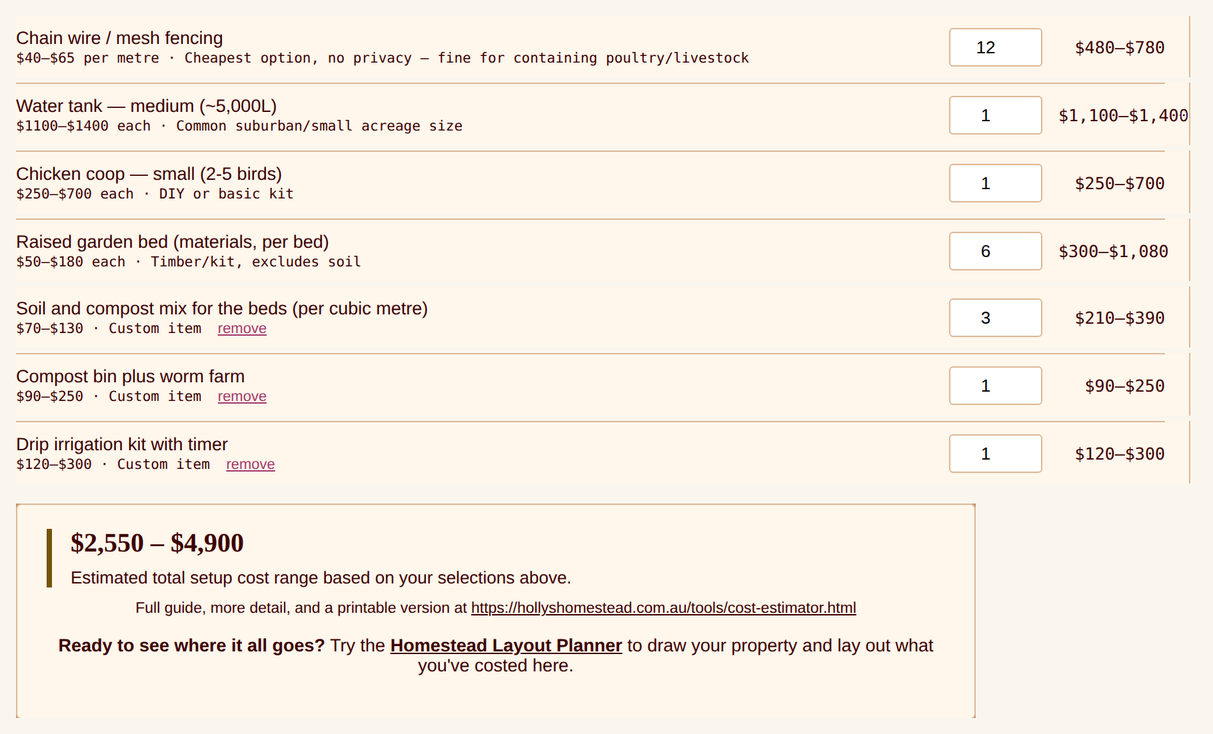
| Line item | Qty | Low | High |
|---|---|---|---|
| Water tank — medium (~5,000 L) | 1 | $1,100 | $1,400 |
| Raised garden beds (materials) | 6 | $300 | $1,080 |
| Chain wire / mesh fencing (metres) | 12 | $480 | $780 |
| Chicken coop — small (2–5 birds) | 1 | $250 | $700 |
| Soil and compost mix (custom) | 3 | $210 | $390 |
| Drip irrigation kit with timer (custom) | 1 | $120 | $300 |
| Compost bin plus worm farm (custom) | 1 | $90 | $250 |
| Total | $2,550 | $4,900 |
What the numbers mean
It's a range, and the range is wide for a reason. The high end is almost twice the low end ($4,900 against $2,550). That gap is the difference between a DIY build from cheap timber and a kit or contractor job, and between a budget tank and a premium one. The tool shows a range deliberately; one number would sound more certain than it is.
Four items make up most of the money. At the high end the tank is $1,400 (about 29% of the total), the beds $1,080 (22%), the fencing $780 (16%) and the coop $700 (14%) — together roughly 80% of the $4,900. That's where quotes and shopping around matter. The three custom items together are $420–$940, small by comparison.
It answers the couple's real question. It's a $2,500–$5,000 project, not $500 and not $10,000. The midpoint is $3,725, a reasonable figure to plan around until quotes come in.
Small changes move it predictably. A small 1,000–2,000 L tank instead of the medium one cuts $400–$475 from the total. If the hen run needed to be dog-proof or private and used Colorbond instead of chain wire, 12 m would cost $960–$1,440 instead of $480–$780, adding $480–$660. The estimator recalculates instantly, so you can test these yourself.
Follow-up prompts worth trying
The first answer is rarely the last. Once the plan is loaded, the same AI conversation can keep refining it:
- “What's the cheapest first stage that gets us eggs and two beds this year, and what would we add next year?” — useful when the full $2,550–$4,900 is more than they want to spend at once.
- “Redo this with a 2,000 L tank instead of the 5,000 L one, and tell me what that changes.” — the AI adjusts one line and you compare the totals.
- “Now work out what the eggs and vegetables would save us each year.” — this is the natural next step, and it leads to the Savings Calculator, which can be filled in by an AI the same way. For a written look at the same question, see what backyard chickens actually cost compared with supermarket eggs.
What to check yourself
An AI is quick at turning a description into a filled-in estimate, which is why this works. It is not a substitute for a few checks that only you can do:
- Count the lines. The tool silently ignores any quantity the AI keyed with the wrong id, so a mistake produces a total that's too low rather than an error. Compare what appears on screen with what you asked for: six beds, one coop, one tank, 12 metres of fencing, and three custom lines.
- Treat the custom prices as the AI's guesses. The soil, compost and irrigation figures came from the AI, not the tool. Check them against a supplier.
- Check your council's rules on keeping hens. Numbers, setbacks and coop siting vary by council and sometimes by property. The Queensland council livestock rules tool is the place to start, then confirm with your own council.
- Know what's not in the total. The hens themselves, feed, seedlings, tools, delivery, and your own time aren't in it. A tank usually needs a base, gutter connections, a first-flush diverter and sometimes a pump, and those are worth asking about in a quote.
- Call 1100 before you dig. Dial Before You Dig is free in Australia and tells you where underground services run before you excavate for a tank base or fence posts.
- Treat the total as a plan, not a quote. The tool's ranges come from public trade pricing compiled in mid-2026, and real prices vary by supplier, season and site access.
Doing this in a different climate?
Most of this example transfers to any part of Australia, because fencing, tanks, coops and beds cost much the same wherever you are. What changes is what else you'd add, and that's the part to tell your AI about by giving it your postcode or climate zone:
- Tropical (Darwin, Cairns): shade cloth and netting for pests matter more than frost protection, and a larger tank helps carry you through the dry season.
- Arid and Mediterranean (Alice Springs, Perth, Adelaide): expect to add shade structures, windbreaks and a bigger tank, and often more soil and mulch because local soils are sandy or poor.
- Cool Temperate (Hobart, Canberra, Melbourne): a greenhouse or cold frame is a likely extra, and as it isn't a preset in this tool, it would go in as a custom item.
- Everywhere: hen-keeping rules differ by state and council. Use the council rules tools for yours, whatever zone you're in.
More examples are being added for other tools and other zones; they're collected on the AI Examples page.