Holly's Homestead — Water
Rainwater Harvesting & Tank Sizing
Capture roof runoff for garden and household backup use
DIFFICULTY Moderate
TYPE One-off setup, ongoing use
TIME A weekend for a basic setup
TYPE One-off setup, ongoing use
TIME A weekend for a basic setup
Difficulty
Moderate
Time
1–2 days setup
Cost
Moderate–high
Best Season
Set up any time
Frequency
Passive once installed
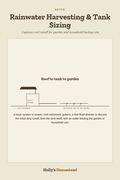
01Roof to tank to garden
A basic system is simple: roof catchment, gutters, a first-flush diverter to discard the initial dirty runoff, then the tank itself, with an outlet feeding the garden or household use.
02What you'll need
- A tank sized to your roof area and rainfall
- Gutters and downpipes in good condition
- A first-flush diverter
- A leaf/debris screen
- A pump if water needs to be pressurised for use
03Method
- 1. Calculate roughly available water: roof area (m²) × rainfall (mm) × 0.8 (accounting for losses) = litres collectable per rain event.
- 2. Size the tank to your intended use — garden-only needs are much smaller than full household backup.
- 3. Install gutter screens to keep leaves and debris out.
- 4. Fit a first-flush diverter so the initial dirty runoff from the roof doesn't enter the tank.
- 5. Connect the tank outlet to garden taps directly (gravity) or via a pump for pressurised use.
04Troubleshooting
- Tank empties faster than expected — check for leaks, or recalculate actual usage against catchment.
- Poor water quality — check gutter screens and first-flush diverter are working, and that the roof material is suitable for water collection.
- Mosquitoes breeding in the tank — ensure all inlets and the tank itself are properly screened and sealed.
- Low pressure at outlets — a gravity-fed system depends on tank height; a small pump solves this for most household uses.
05Timing & maintenance
Best time
Install before the wettest season in your region so the tank can fill from the start.
Duration
A basic setup can be done in a weekend; larger systems with pumps and plumbing take longer.
Maintenance
Clean gutter screens and first-flush diverters a few times a year; check the tank for sediment periodically.
Signs of success
Consistent water availability through dry spells, without running the tank dry between rain events.
06Tips & variations
Pairs well with
Drip Irrigation SetupGreywater SystemsCommon mistakes
Undersizing the tank for the intended useSkipping the first-flush diverter, leading to poor water qualityPro tip
Even a modest tank dramatically reduces mains water use for the vegetable garden — you don't need to capture 100% of runoff to make a difference.