
How Much Do We Need to Grow? A Darwin Yearly Food Plan With an AI Assistant
A worked example of the Yearly Food Self-Sufficiency Planner and an AI assistant working together: an invented couple in Darwin list what they actually eat in a week, and the planner works backwards to how much ground, how many plants and how many hens that takes over a year. Every number is read off the real tool.
At a glance
- Tool: Yearly Food Self-Sufficiency Planner
- Scenario: couple in Darwin planning around what they already eat
- Climate zone: Tropical (Darwin and the NT Top End)
- Handoff method: a direct link (about 711 characters)
- Result: about 52 m² of vegetable beds, plus 5 hens, 6 banana plants, 2 mango trees, 2 passionfruit vines and a pawpaw
The situation
Imagine a couple in Darwin. They don’t want a theoretical garden; they want to grow the things they already eat. They know roughly what ends up on their plates in a normal week — sweet potato, snake beans, a bit of okra, eggs most mornings, a banana or two, a few slices of pawpaw, and mango and passionfruit when they’re around — and they’d like to know what it would take to cover that from the back yard.
That’s the reverse of the Block Planner, which starts from space and asks what fits. The Yearly Food Self-Sufficiency Planner starts from appetite: how much of each food you eat, how often, and for how many people. It then works out how much you’d have to grow or keep over a year, with a safety buffer for losses.
What they tell the AI
No technical knowledge is needed. This is everything the person supplies:
- Two people in the household.
- What they eat in a typical week: a sweet potato each twice a week, a serve of snake beans twice a week, three okra pods each twice a week, a taro once a week.
- Two eggs each, four mornings a week.
- A banana each four times a week, 100 g of pawpaw twice a week, half a mango each twice a week and a passionfruit each twice a week.
- A 15% buffer for spoilage, pests and the occasional failed crop.
The prompt
Every handoff tool on this site has a Copy AI Prompt button that puts a ready-made instruction on your clipboard. They paste it into their AI assistant and fill in the bracketed part:
The detail in the bracketed part does the work: what they eat, how often, and how many people. The AI isn’t inventing a diet, it’s translating one.
What the AI does, step by step
- Reads the tool page. It finds the embedded format block and learns that a plan is a list of entries, each with an
itemId, a number of times per week (freq) and a portion size per person (qty), plus the household size and buffer. - Finds the real item ids. The page only reveals its food ids once a category is chosen in the form, so a careful AI reads the actual options (for example
sweet-potato,snake-beans,okra,eggs,banana,pawpaw,mangoandpassionfruit) rather than guessing names. - Converts the couple’s habits into portions. Whole items such as sweet potato and eggs are counted in units; weight-based foods such as pawpaw use fractions of a kilogram, so 100 g becomes 0.1. Each portion value has to be one the tool offers.
- Sets the household and buffer. Household 2, buffer 15.
- Builds the link. Nine entries fit comfortably in a link of about 711 characters.
- Explains what the tool does with it. For each food the planner multiplies the portion by the household, the times per week and 52 weeks, adds the buffer, and then works out how many plants, trees or animals that takes from a typical yield each, and how much ground the plants need from their spacing.
What the AI hands back
One link. Opening it fills in the household, the buffer and all nine foods, and each food’s card appears straight away. Nothing is uploaded and no account is needed.
Open this exact plan in the Yearly Food Planner →
For a copy to keep, the AI would produce this file instead. Save it with a .json extension (a .txt with the same content also works) and load it with the tool’s Import a Saved File button:
{
  "slots": {
    "Darwin couple yearly plan": {
      "household": "2",
      "buffer": "15",
      "plan": [
        {
          "itemId": "sweet-potato",
          "freq": 2,
          "qty": 1
        },
        {
          "itemId": "snake-beans",
          "freq": 2,
          "qty": 1
        },
        {
          "itemId": "okra",
          "freq": 2,
          "qty": 3
        },
        {
          "itemId": "taro",
          "freq": 1,
          "qty": 1
        },
        {
          "itemId": "eggs",
          "freq": 4,
          "qty": 2
        },
        {
          "itemId": "banana",
          "freq": 4,
          "qty": 1
        },
        {
          "itemId": "pawpaw",
          "freq": 2,
          "qty": 0.1
        },
        {
          "itemId": "mango",
          "freq": 2,
          "qty": 0.5
        },
        {
          "itemId": "passionfruit",
          "freq": 2,
          "qty": 1
        }
      ],
      "savedAt": "2026-10-05T00:00:00.000Z"
    }
  }
}
The result
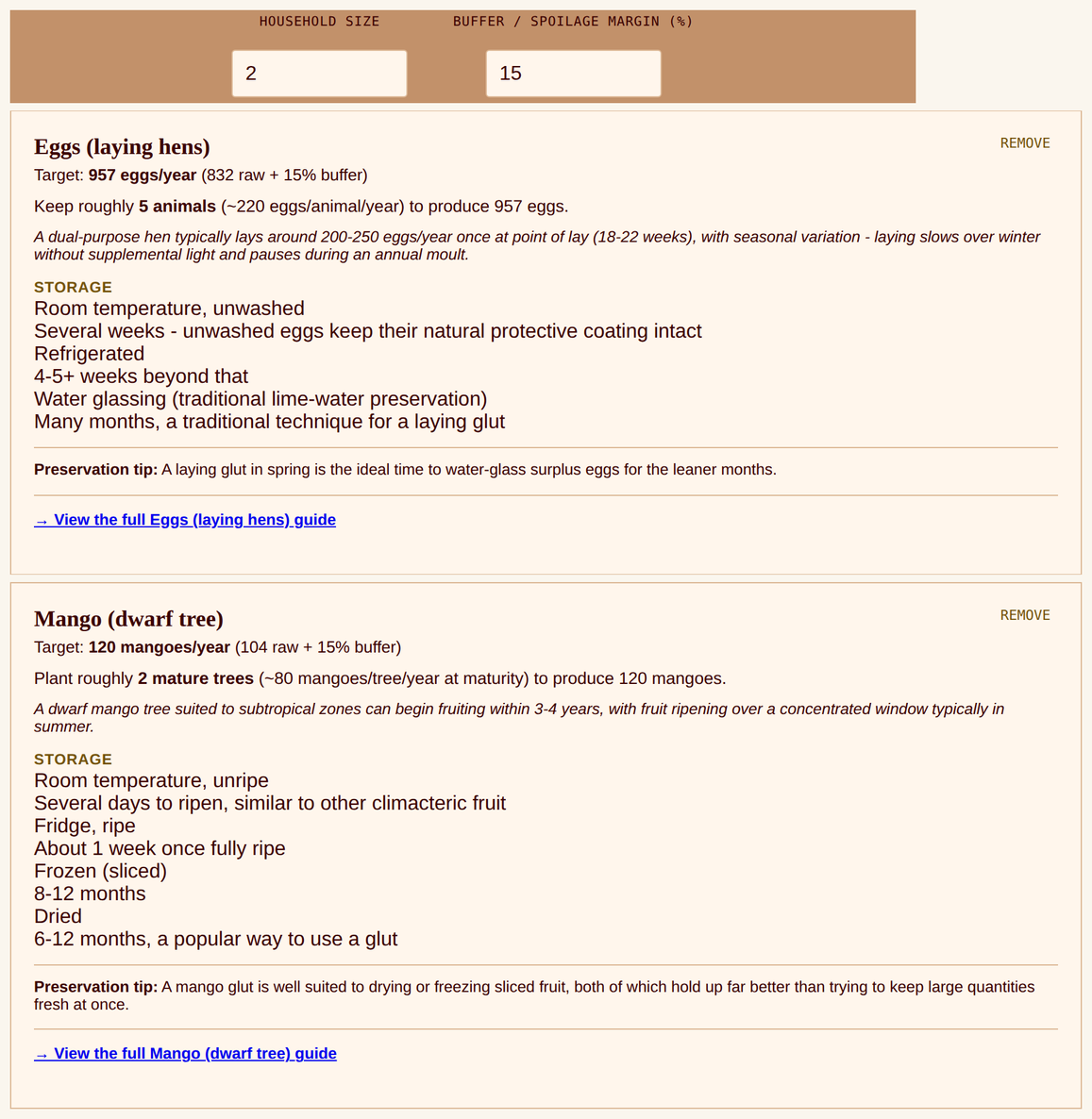
This is the real tool after loading that link. Each food gets its own card with a yearly target, how much to grow or keep, and storage and preservation notes; two of the nine are shown here, and the full results are in the table below.
| Food | What the couple eat | Yearly target (with buffer) | What to grow or keep |
|---|---|---|---|
| Sweet Potato | 1 sweet potato, 2× a week | 240 sweet potatoes | 20.0 m² |
| Snake Beans | 1 serve, 2× a week | 240 serves | 7.3 m² |
| Okra | 3 pods, 2× a week | 718 okra pods | 4.8 m² |
| Taro | 1 taro, 1× a week | 120 taro | 20.0 m² |
| Eggs | 2 eggs, 4× a week | 957 eggs | 5 animals (laying hens) |
| Banana | 1 banana, 4× a week | 479 bananas | 6 mature plants |
| Pawpaw | 100 g, 2× a week | 24 kg of pawpaw | 1 mature tree |
| Mango | ½ a mango, 2× a week | 120 mangoes | 2 mature trees |
| Passionfruit | 1 passionfruit, 2× a week | 240 passionfruit | 2 mature vines |
What the numbers mean
Four crops need ground, and sweet potato and taro need the most. Sweet potato, snake beans, okra and taro together need about 52 m². Sweet potato and taro take 20 m² each because each plant gives roughly one tuber a season in the planner’s model, and at 12 and 6 plants per square metre that adds up. Okra needs only 4.8 m² for 718 pods, because the planner counts about 10 pods from each of roughly 72 plants. It’s a reminder that a crop that keeps producing from one plant, like okra or snake beans, takes far less room than one that gives a single harvest per plant.
The tree crops need patience, not ground. Six banana plants, two mango trees, two passionfruit vines and one pawpaw cover the fruit, and the planner counts them at maturity. The mango card itself notes fruit within 3–4 years. Annual crops pay back in a season; trees are a longer plan, and the vines and pawpaw come in sooner.
Five hens cover the eggs. 957 eggs a year with the buffer, at about 220 eggs per hen per year, means five hens. The couple eat more eggs than they’d guess: two each, four mornings a week, is 832 eggs before the buffer.
It plans what they listed, not a whole diet. The planner turns a list of foods into quantities. It doesn’t count calories, protein or the staples this plan leaves out, such as rice, flour, dairy and meat, so it’s a plan for these nine foods, not for feeding two people.
Follow-up prompts worth trying
The first answer is rarely the last. The same conversation can keep refining the plan:
- “Which of these gives the most food for the least ground, and which would you cut to save space?” — useful before pulling out a lawn.
- “Will all of this fit in a 900 m² Darwin block?” — the Block Planner checks that. Note it allows 81 m² for a mango tree, so check whether that much space is available.
- “What would it save us each year?” — the Savings Calculator takes the same sort of handoff; see the Sydney example.
What to check yourself
An AI is quick at turning a description into a filled-in tool, which is why this works. It is not a substitute for checks only you can do:
- Make sure the plan actually shows. If a food id is wrong, the planner skips just that item without any error, so count the cards: a plan with nine foods should show nine. If one is missing, ask the AI to re-check its id against the tool’s food list.
- Check the portions against how you really eat. A whole sweet potato per person twice a week is a lot for some people and not much for others. The plan is only as good as the habits it starts from.
- Yields are typical, and trees are counted at maturity. A young tree, a poor wet season or a pest year will all fall short of the planner’s figures, which is what the buffer is for.
- Timing matters in the tropics. The planner tells you how much, not when. Darwin has a wet and dry season rather than four seasons, so use the grow guides and your climate zone for planting windows.
- Check council rules for hens. Numbers and housing rules vary; see the NT council livestock rules and confirm with your own council.
Doing this in a different climate?
The planner works the same way anywhere; the foods are what change. Tell your AI your postcode or climate zone so it picks suitable foods:
- Subtropical and Warm Temperate (Brisbane, Sydney): a wider mix, with tomatoes, beans, zucchini and citrus doing well, plus the tropical fruits on the warmer coast.
- Mediterranean (Perth, Adelaide): expect olives, figs, citrus, grapes and winter greens, with summer crops reliant on irrigation.
- Cool Temperate (Hobart, Canberra, Melbourne): apples, pears, berries, brassicas, potatoes and root crops dominate, with a short summer for tomatoes.
- Arid (Alice Springs): fewer food choices, more shade and irrigation planning, and smaller yields per square metre than the planner’s typical figures.
More examples, across other tools and climate zones, are on the AI Examples page.