
Cutting the Grocery Bill: A Sydney Backyard Savings Estimate With an AI Assistant
A worked example of the Savings Calculator and an AI assistant working together: an invented Sydney family of four describes the vegetables, fruit, herbs and eggs they could produce at home, the AI turns it into quantities, and the tool puts a dollar value on it — $1,701–$2,591 a year of food they wouldn’t have to buy. The numbers are read off the real tool, and the page spells out why that figure is a value, not a profit.
At a glance
- Tool: Savings Calculator
- Scenario: family of four, normal suburban yard, aiming to cut the grocery bill
- Climate zone: Warm Temperate (Sydney basin and coastal NSW)
- Handoff method: a direct link (about 439 characters)
- Result: $1,701–$2,591 estimated annual value
The situation
Imagine a family of four in suburban Sydney. The weekly shop has crept up, and they’ve noticed that salad, herbs and eggs seem to cost more every month. They have a back yard, a free weekend or two, and no particular wish to become farmers. They just want to know what growing some of their own food is actually worth.
That is the question the Savings Calculator answers. For each crop or animal you tell it how much you’d produce in a year, and it multiplies by typical Australian shop prices (shown on each row) to give a range. The AI’s job is the hard-to-guess part: what is a realistic quantity for a family on a suburban block?
What they tell the AI
No technical knowledge is needed. This is everything the person supplies:
- A family of four in suburban Sydney with a normal back yard.
- The goal: cut the grocery bill, not become self-sufficient.
- Crops they like and use: tomatoes, zucchini, cucumber, capsicum, lettuce, silverbeet, kale, green beans, potatoes, onions, garlic and carrots.
- One lemon tree, and the herbs they buy most: basil, parsley and coriander.
- Four laying hens.
- A request for realistic home-garden yields, not market-farm yields.
The prompt
Every handoff tool on this site has a Copy AI Prompt button that puts a ready-made instruction on your clipboard. They paste it into their AI assistant and fill in the bracketed part:
The last sentence is the family’s own addition. Without it an AI may happily assume yields that a keen market gardener could reach but a busy family won’t.
What the AI does, step by step
- Reads the tool page. It finds the embedded format block and learns that every quantity goes under
values, keyed by ids that start withsav-, followed by the crop name in lower case. - Learns the unit for each row. Most rows are kilograms per year. Eggs are dozens per year, and the animal-meat rows are animals per year. This matters: an AI that enters “4” for four hens would be entering four dozen eggs.
- Picks realistic quantities. It chooses amounts a family can actually harvest from a suburban yard: for example 40 kg of tomatoes, 20 kg of zucchini, 30 kg of potatoes and 30 kg of lemons from a tree, plus about 1 kg each of the three herbs. Four hens lay roughly 220 eggs each a year in the site’s Complete Homestead Planner data, so it enters 60 dozen, which is a little under what four hens produce.
- Leaves out what it can’t justify. No pumpkins, no orchard, no meat animals, none of the crops that need much more space or a hot summer than a Sydney suburban yard comfortably offers.
- Builds the link. Seventeen items fit comfortably in a link of about 439 characters.
- Says what the number is. A good AI response ends by pointing out that this is the shop value of the food, before any costs.
What the AI hands back
One link. Opening it fills in all 17 quantities and the total appears immediately. Nothing is uploaded and no account is needed.
Open this exact plan in the Savings Calculator →
For a copy to keep, the AI would produce this file instead. Save it with a .json extension (a .txt with the same content also works) and load it with the tool’s Import a Saved File button:
{
  "slots": {
    "Sydney grocery-cutting garden": {
      "values": {
        "sav-tomato": 40,
        "sav-cucumber": 10,
        "sav-zucchini": 20,
        "sav-capsicum": 6,
        "sav-lettuce": 12,
        "sav-silverbeet": 10,
        "sav-kale": 6,
        "sav-beans": 8,
        "sav-carrot": 15,
        "sav-onion": 10,
        "sav-garlic": 2,
        "sav-potato": 30,
        "sav-lemon": 30,
        "sav-basil": 1,
        "sav-parsley": 1,
        "sav-coriander": 1,
        "sav-laying-hens": 60
      },
      "savedAt": "2026-10-05T00:00:00.000Z"
    }
  }
}
The result
This is the real tool after loading that link: the 17 filled-in rows and the summary box.
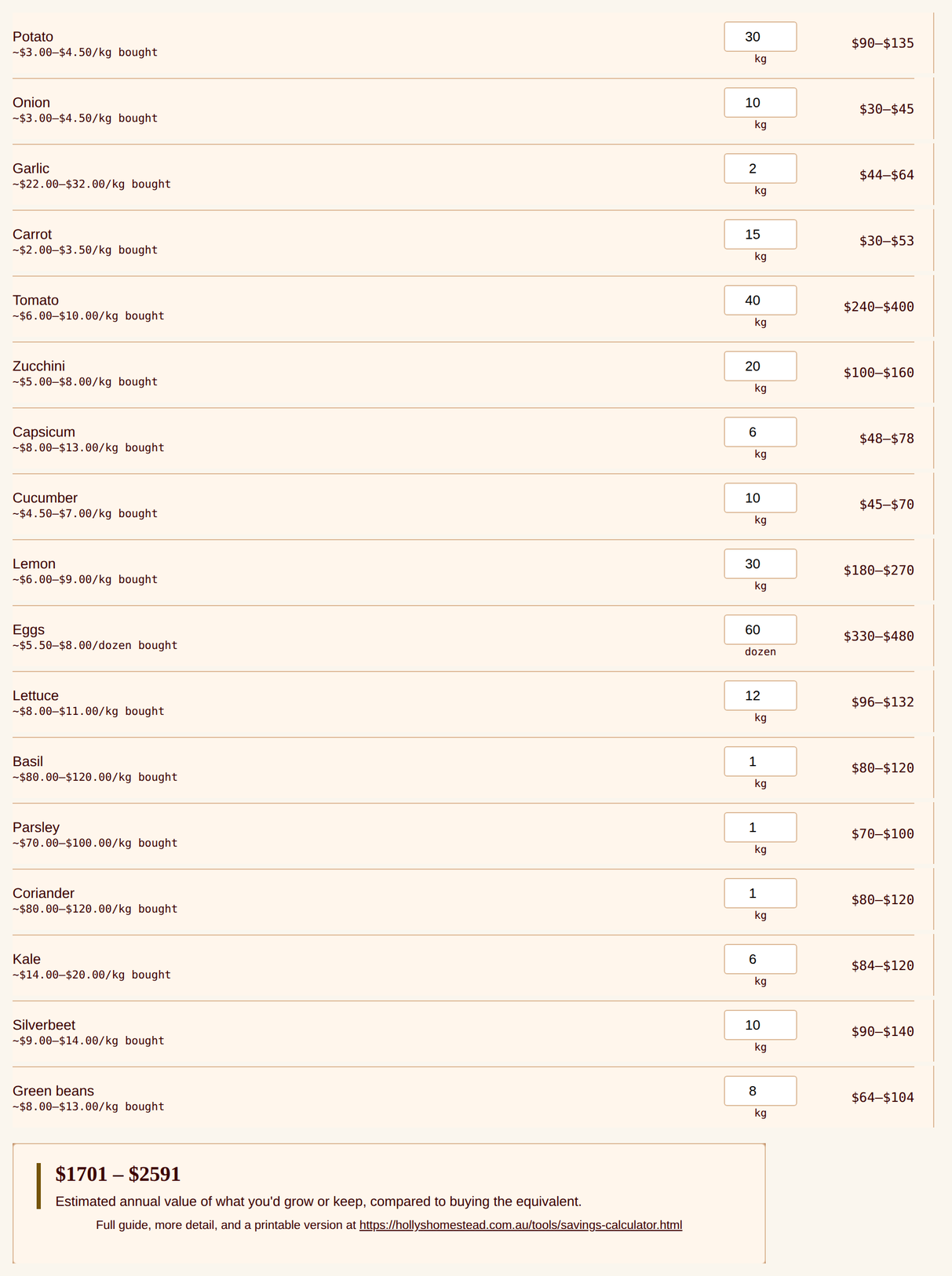
| Item | Quantity per year | Low | High |
|---|---|---|---|
| Eggs (dozens) | 60 dozen | $330 | $480 |
| Tomato | 40 kg | $240 | $400 |
| Lemon | 30 kg | $180 | $270 |
| Zucchini | 20 kg | $100 | $160 |
| Silverbeet | 10 kg | $90 | $140 |
| Potato | 30 kg | $90 | $135 |
| Lettuce | 12 kg | $96 | $132 |
| Kale | 6 kg | $84 | $120 |
| Basil | 1 kg | $80 | $120 |
| Coriander | 1 kg | $80 | $120 |
| Green beans | 8 kg | $64 | $104 |
| Parsley | 1 kg | $70 | $100 |
| Capsicum | 6 kg | $48 | $78 |
| Cucumber | 10 kg | $45 | $70 |
| Garlic | 2 kg | $44 | $64 |
| Carrot | 15 kg | $30 | $53 |
| Onion | 10 kg | $30 | $45 |
| Total | $1,701 | $2,591 |
What the numbers mean
It’s a value, not a profit. $1,701–$2,591 is what the same food would cost at the shop. It doesn’t subtract seed, soil, feed, water, tools or a hen coop. Treat it as the top of the ledger and keep the costs in mind; the Setup Cost Estimator example shows what the one-off costs for a similar backyard can look like.
Eggs and tomatoes lead. The eggs are worth $330–$480 (about 19% of the high end) and the tomatoes $240–$400 (about 15%). Together with the lemon tree ($180–$270) they make up about 44% of the high end from just three things.
Small things, big prices. The three herbs are only about 3 kg of harvest in total but worth $230–$340, because shop herbs are priced per tiny bunch. That’s roughly 13% of the high end from a few pots. The big, cheap vegetables such as potatoes ($90–$135) and onions ($30–$45) are worth far less per kilogram than the herbs, even though they take much more garden.
It tells the family where to start. If the goal is the grocery bill, hens, tomatoes, herbs and salad greens give the most value for the least ground. Staple vegetables matter more for self-sufficiency than for shop savings.
Follow-up prompts worth trying
The first answer is rarely the last. The same conversation can keep refining the plan:
- “What would the number look like if we only did the five best-value items?” — useful for a family who wants to start small.
- “What would all of this cost us to set up and run?” — the Setup Cost Estimator takes the same kind of handoff.
- “Will this all fit in a 400 m² yard?” — the Block Planner can check space; see the Perth Hills example.
- “How much of our whole year’s food would that be?” — the Yearly Food Self-Sufficiency Planner is built for that question.
What to check yourself
An AI is quick at turning a description into a filled-in tool, which is why this works. It is not a substitute for checks only you can do:
- Check the units. Eggs are entered in dozens, not hens, and animal rows are numbers of animals. If a total looks far too low or high, a wrong unit is the usual cause.
- Check the quantities against your own yard. 40 kg of tomatoes needs a good sunny bed and a decent season. The AI’s numbers are plausible for a keen household, not a guarantee.
- Remember it ignores your costs. The estimate is what the food would cost to buy, not what you save once seed, feed and equipment are counted.
- Shop prices are ranges and they move. The tool’s per-kilogram prices are typical Australian figures; check them against what you actually pay, especially for herbs.
- Check council rules for hens. Numbers and siting vary by council, so see the NSW council livestock rules and confirm with your own council.
Doing this in a different climate?
The calculator is the same everywhere; what changes is what a household can realistically grow, and where the biggest savings sit. Tell your AI your postcode or climate zone:
- Tropical and Subtropical (Darwin, Brisbane): warm-season crops like beans, chilli, okra and sweet potato do well nearly year-round, and fruit like mango, banana and passionfruit can carry the plan.
- Mediterranean (Perth, Adelaide): expect strong summer crops with irrigation, and citrus, figs and olives to be good-value fruit.
- Cool Temperate (Melbourne, Hobart, Canberra): shorter summers mean less tomato and capsicum, and more apples, pears, berries, brassicas and root crops.
- Arid: water, not space, limits yields, so expect smaller quantities than the Sydney example.
More examples, across other tools and climate zones, are on the AI Examples page.