Holly's Homestead — Vine Fruit
Kiwi Berry
Actinidia arguta · Kiwifruit family
DIFFICULTY Moderate
TYPE Deciduous perennial vine
MATURITY 3–5 years to first fruit
TYPE Deciduous perennial vine
MATURITY 3–5 years to first fruit
Sun
Full sun
Water
Regular, deep
Soil pH
6.0–6.5
Spacing
1–2m apart on a trellis
Depth
as per pot
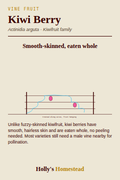
01Smooth-skinned, eaten whole
Unlike fuzzy-skinned kiwifruit, kiwi berries have smooth, hairless skin and are eaten whole, no peeling needed. Most varieties still need a male vine nearby for pollination, though some (like Issai) are partly self-fertile.
02Planting
Method
Plant against a strong, permanent pergola-style structure — vines get heavy.
Soil
Rich, well-drained, high organic matter.
Timing
Plant in winter while dormant, or from a potted vine in spring.
Planting timing varies significantly by Australian climate zone. Set your zone above (or use the Find My Climate Zone tool) for guidance tailored to your own area.
03Growing care
- Plant a male vine nearby unless growing a self-fertile variety like Issai.
- Keep roots consistently moist — kiwi berries have shallow roots that dry out fast.
- Prune hard each winter — vines are extremely vigorous.
- Provide a strong permanent structure — mature vines get heavy.
04Problems
- No fruit produced — usually a missing male pollinator vine, unless growing a self-fertile variety.
- Wind damage to young growth — shelter young vines.
- Fruit fly — less commonly affected than other fruit.
- Root rot — from poor drainage; ensure it's not sitting wet.
05Harvest & storage
Signs
Fruit has coloured up and gives slightly when gently squeezed.
Method
Twist gently from the vine; eaten whole, skin and all, no peeling needed.
Curing
Ripens further at room temperature if picked slightly firm.
Storage
Fridge, up to 2 weeks once ripe.
Preserving
See Dehydrating (drying grapes and similar fruit) or Canning & Bottling (jams and preserves) for ways to keep a harvest surplus.
06Companions & rotation
Plant nearby
ComfreyAvoid nearby
Weak structuresRotation note
Not applicable — long-lived perennial vine.