
Why We Built Holly's Homestead
We built Holly's Homestead because the helpful Australian homesteading information that did exist was scattered across dozens of different sites, forums, and magazines — so instead of writing yet another single blog, we pulled it into one properly structured, searchable place, and then kept building until it covered growing, animals, infrastructure, and the planning maths behind all of it.
Quick video summary of our Kale guide, referenced above.
When we started planning our own move toward self-sufficiency, we did what most people do first: we went looking for good information. And to be fair, we found some useful things along the way — The Diggers Club has solid heirloom seed and growing knowledge specific to Australian conditions, and Pip Magazine has some thoughtful permaculture and self-sufficiency writing. It's not that nothing good existed for Australia. It's that it was scattered — a solid growing tip here, a decent livestock forum thread there, a magazine article buried behind a paywall, none of it connected to the rest, none of it organised in a way that let you actually plan a whole property against it. We'd spend an evening piecing together enough to make one decision, and start from scratch the next week for a different one.
So Holly's Homestead didn't start as an attempt to invent something from nothing. It started as an attempt to actually connect the good information that already existed into one coherent, properly structured place — and then, once we were building anyway, to fill in the gaps we kept running into: Australian climate-zone-specific planting calendars, regional rainfall and sun-hour data for infrastructure planning, and the kind of exact, checkable planning maths that a scattered collection of blog posts and forum threads was never going to give us.
Who's Actually Behind This
Holly and I aren't agricultural scientists or career farmers, and we don't pretend otherwise anywhere on this site. We're a family working through the same practical decisions most people reading this are working through — how much land is actually enough, what to plant first, which animals make sense for the space and time we have, and how to avoid the expensive mistakes that come from guessing rather than knowing. What we do bring to it is a stubbornness about not publishing anything we haven't actually checked, and enough of a technical background between us to build the kind of structured, searchable, properly-referenced resource that a lot of good homesteading knowledge never gets turned into.
That distinction matters more than it might sound. Plenty of homesteading content comes from people with deep hands-on experience, but that knowledge often stays trapped in a format that's hard to actually use — a long personal blog post, a Facebook group thread, a YouTube video you can't skim. We wanted to sit in the useful middle: research, Australian data, checked properly, organised the way we'd actually want to use it ourselves, in one place instead of fifteen tabs.
The Gaps We Had to Fill Ourselves
Consolidating what already existed got us a long way, but it didn't get us all the way. Some things simply didn't exist anywhere we could find, in any format. How much space does a coop actually need for a specific number of birds? How many kilograms of hay will three goats actually get through over a winter? What size rainwater tank does a specific roof, in a specific rainfall zone, support? Questions like these don't have a simple written-guide answer — they need a calculation, run against regional data, for your actual numbers, not a rule of thumb copied from a forum post written for a different climate. That gap became the reason the site grew well beyond guides and turned into a set of working tools too.
Every Kind of Content on the Site, and Why Each One Exists
The site isn't one thing — it's built from several different content types, each solving a different part of the same underlying problem. We didn't set out to build all of these at once; each one got added because a single format kept failing to cover a need.
Grow Guides are the foundation — one-page, printable reference guides for growing a huge range of vegetables, herbs, fruit, and nuts, organised around six Australian climate zones (Tropical, Subtropical, Warm Temperate, Mediterranean, Cool Temperate, and Arid) rather than a single calendar. Set your zone once, and the planting and harvest advice on every single guide adjusts to match. We built these to be usable at a glance — spacing, watering needs, common problems, not padded-out prose you have to scroll past to find the actual number you needed.
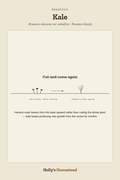
The actual diagram from our Kale grow guide — every guide has one, built from the same data as the printable card.
Animal Guides cover the livestock people actually keep on Australian suburban and small-acreage blocks — poultry, goats, sheep, pigs, rabbits, and bees — with the same one-page, straight-to-the-point approach, plus space requirements rather than vague "give them plenty of room" advice that leaves you guessing until you've already built something the wrong size.
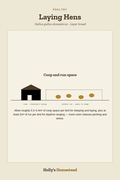
The diagram from our Laying Hens guide — the same style used across all 13 animal guides.
How-To Guides are the skills layer sitting underneath both of those — propagation, soil and composting, water systems, pest and disease management, preserving, off-grid energy, and land management. These are the guides for the parts of homesteading that aren't about a single crop or animal, but about the systems that support all of them, and they were the last major content type we added, once it became obvious that growing and keeping animals well both depend heavily on getting these underlying systems right first.
Deep-dive companion articles exist alongside every single one of the guides above — a long-form article for each grow guide, animal guide, and how-to guide, going into more depth than the one-page format allows, with a full FAQ section built from the guide's own data. If the printable card is the quick reference you take out to the garden, the companion article is the version for when you actually want to sit down and understand the reasoning behind it, or you're deciding whether a particular crop or animal is right for your situation in the first place.
The blog is where the more opinionated, story-driven content lives — comparisons like chickens vs ducks vs quail, honest breakdowns like the cost of setting up a homestead, and our own first-year mistakes, written plainly rather than dressed up. This is also where we've tried to be most honest about the limits of our own experience — noting where a recommendation is a best-practice figure versus our own specific circumstances, which won't always match yours exactly.
And the Glossary exists because we kept running into homesteading terms that got thrown around constantly without ever being properly explained — what a nitrogen fixer actually does, the difference between hilling and mounding a crop, what a dry period means for a dairy animal. It's grown into a large reference, built from the actual terminology used across the site's own content rather than a generic list assembled from nowhere in particular, searchable and browsable by category, and it's one of the parts of the site we expect to keep growing the most as we keep writing.
Every Tool on the Site, and How to Actually Use Each One
Guides can only take you so far before the question becomes personal maths — not "how do chickens work" but "how many can I actually fit, and what will it cost me specifically." That's the gap the tools are built to close, and it's the part of the site we're proudest of, since this is the part we couldn't find scattered anywhere else to consolidate — it simply didn't exist in this form. Every one of them is free, and every one uses Australian data behind the scenes — rainfall figures by region, peak sun hours, husbandry space requirements pulled from sources. They're organised into three groups, and it's worth knowing roughly what each group covers before diving into individual tools.
Garden & Vegetable Growing Calculators
This group handles the planning side of growing — what to plant when, how much space it needs, and what to do when something's gone wrong. The Planting Calendar and Harvest Calendar work the same way — pick a month, and see what's good to plant or ready to pick right now, adjusted for your zone. The Find My Climate Zone tool is worth using first if you're not sure which zone applies to you: enter your postcode, and it sets your zone site-wide automatically, so every other zone-aware tool and guide picks it up without you having to set it again on every page.
The Homestead Block Planner is the master planning tool in this group — enter your block dimensions and household size, and it works out space requirements for the crops and animals you actually want, rather than you guessing and hoping it fits once everything's already in the ground. The Companion Planting Checker tells you whether two specific crops are good neighbours or best kept apart, pulled from the pairings noted across our own guides rather than folklore repeated without checking. The Crop Rotation Planner tracks what's been growing in each of your beds and warns you before you repeat the same plant family too soon, which matters more for soil health and disease prevention than most beginners realise until they've had a bad season.
If something's gone wrong in the garden, Symptom Search lets you describe the problem and searches across every guide's troubleshooting section at once, rather than you trying to guess which of 134 guides might mention your specific issue. The Troubleshooting Directory is the full crawlable index behind it, if you'd rather browse by symptom category than search by keyword.
Animal & Livestock Calculators
This is the largest tool group on the site, and the one that took the most research to get right, since housing and feed requirements differ by species in ways a single blanket recommendation tends to flatten out. Each animal has its own dedicated space, materials, and cost planner, built around that specific animal's housing needs rather than a one-size-fits-all formula: Chicken Coop Planner, Duck Housing Planner, Goose Housing Planner, Turkey Housing Planner, and Quail Aviary Planner for poultry, plus Goat Paddock Planner, Sheep Paddock Planner, Pig Pen Planner, and Meat Rabbit Hutch Planner for larger livestock. Enter your animal count and pick a budget tier, and each one gives you dimensions, an itemised materials list, and a cost estimate across three tiers, not a single vague number that doesn't account for how you actually want to build.
The Beehive Setup & Honey Yield Planner works differently, since beekeeping isn't really a space question the way the others are — it calculates frame counts, equipment needs, and a conservative honey yield estimate instead, built around sourced Australian production figures rather than an optimistic guess. Once you've got animals breeding, the Livestock Breeding & Hatch Date Calculator gives you a expected due or hatch date from your mating or egg-laying date, covering every animal on the site in one place. The Livestock Feed & Hay Budgeter works out annual hay bale and grain bag counts so feed costs stop being the surprise line item that catches so many new homesteaders out in their first winter. The Seasonal Production Calendar rounds this section out by showing when to expect more or less from your animals across the year, rather than assuming flat, year-round output that simply isn't how egg-laying or milk production actually works.
Homestead Planning & Infrastructure Calculators
This group covers the bigger, less glamorous decisions that make or break a homestead budget — water, power, heating, and the overall cost of getting set up in the first place. Before you build anything, the Setup Cost Estimator gives Australian ballpark ranges for fencing, tanks, and dedicated housing for every animal, plus the other big-ticket items, and the Savings Calculator gives an honest sense of what growing or keeping your own actually saves once you're up and running, rather than an inflated number designed to make the whole project sound better than it is.
For water and power specifically, the Rainwater Harvesting Calculator uses your roof area and regional rainfall data to recommend a tank size, and the Solar & Off-Grid Load Estimator works out daily energy use from the appliances you actually plan to run, sized against Australian peak sun hour data. The Firewood Consumption Planner does the same job for winter heating, using cubic metres, the way firewood is actually bought and sold here, rather than the cord measurement most calculators default to.
The Pantry & Home Preserving Inventory Planner tells you how long your preserved stock will last at your household's consumption rate, with proper food safety guidance built in rather than treated as an afterthought to a fun calculator. And if all of this feels like a lot to take in at once — it is a lot, we know — the Beginner Starter Kit is designed specifically to cut through that. Tell it your available space and what you're interested in, and it hands back a short, sensible list of the easiest, most space-efficient guides to actually start with, rather than leaving you to work out where to begin on your own.
Built to Actually Be Found, Not Just to Exist
None of this is much use if nobody can find it, so we've been deliberate about how the site is built technically, not just what's on it. Every guide, tool, and article carries structured data — proper schema for articles, FAQs, and how-to content — because that's what helps search engines and AI systems understand and accurately represent what a page actually contains, rather than guessing from unstructured text. The site also publishes an llms.txt file, a plain-language map of the site specifically intended for AI systems to read directly, and every guide links naturally to related guides, relevant tools, and glossary terms where a term is used in context, rather than links stuffed in for their own sake.
That combination is a part of why the site is starting to get picked up the way it is — including by Google's own AI Overview system citing it directly by name for "homesteading in Australia" searches within the first couple of weeks of launch. That's not an accident of good luck; it's a fairly direct result of building the technical foundation properly from day one, alongside the content itself, rather than treating discoverability as something to bolt on afterwards once the writing was already done. It also matters for a more basic reason than rankings: a site that's easy for a crawler or an AI system to parse correctly is also, almost always, a site that's easy for an actual person to navigate and trust.
How We Try to Keep This Accurate
A site this size is only as useful as it is trustworthy, and we've tried to hold ourselves to a standard on that rather than just claim one. Where a figure needed research — rainfall averages, regional peak sun hours, livestock feed intake rates, actual gestation and incubation periods — we went and found the number rather than estimating something plausible-sounding and moving on. Where we weren't confident something was accurate, we said so directly in the guide itself, rather than presenting a guess with the same confidence as a verified fact. And where a tool's output depends on an assumption that varies — pasture access changing hay needs, elevation affecting a postcode's climate — we've tried to say that plainly too, instead of pretending a calculator can capture every variable perfectly.
We'd rather the site be a little more honest about its own limits than a lot more impressive-sounding and wrong. That's also why the reviews on this page are testimonials from actual people using actual tools and guides — not manufactured social proof, and not AI-generated praise dressed up as a review. If something on the site is wrong, we'd rather hear about it and fix it than have it sit there looking polished.
Where This Goes From Here
The site isn't a finished, static thing we built once and walked away from. New guides, new tools, and deeper regional content keep getting added as we find gaps worth filling, and we're actively working on gathering photos from our own homestead to sit alongside the guides rather than relying on diagrams alone. We're also looking at deeper, state-specific regulatory content, since council rules are the one part of homesteading that no amount of good gardening advice can substitute for getting right.
One of the more recent additions is My Notebook — a free way to save any guide, tool, or article to come back to later, with absolutely no account, sign-up, or login required. Click Bookmark on anything, and it's stored right in your own browser; come back whenever you like and it's still there. We built it this way deliberately — we didn't want to add another password to remember just to bookmark a few grow guides, so we didn't.
If you're on your own path toward growing more of your own food, keeping animals, or just becoming a little more self-sufficient on whatever land you have — a suburban block or a rural property — we'd recommend starting with the site's own complete guide to homesteading in Australia, which pulls the whole library together in one place.
Useful starting points if you're new here:
- Find My Climate Zone — set your zone once, everything else adjusts automatically
- Beginner Starter Kit — a sensible shortlist if the size of the site feels overwhelming
- Homestead Block Planner — work out how much space your actual plans need
- My Notebook — save anything you find useful to come back to later, no account needed
- Glossary — plain-language definitions for any term that doesn't make sense yet
- Homesteading in Australia: The Complete Guide — the full picture in one place
Frequently Asked Questions
Why did you build Holly's Homestead?
Because every homesteading resource we found online was written for a different climate, different council rules, and a different growing season - so we built the Australian-specific resource we actually needed ourselves.
What's the difference between a grow guide and a companion article?
The grow guide is a one-page, printable quick reference. The companion article is a longer, more in-depth version of the same guide, with a full FAQ section, for when you want to understand the reasoning rather than just the numbers.
Is everything on the site actually free?
Yes, every guide, printable card, and tool is free. That's been a deliberate choice from the start, not a placeholder business model.
How many tools does the site have?
70 free interactive tools across garden and growing, animal and livestock, and homestead infrastructure planning - each using Australian data rather than generic estimates.
Do I need to create an account to save anything on the site?
No. My Notebook lets you save any guide, tool, or article to come back to later, stored entirely in your own browser, with no sign-up, login, or email ever required.