Holly's Homestead — Garden Systems & Structures
Pruning Basics
Shape and renew plants with confident, correct cuts
DIFFICULTY Moderate
TYPE Ongoing seasonal practice
TIME Varies by plant and scale
TYPE Ongoing seasonal practice
TIME Varies by plant and scale
Difficulty
Moderate
Time
Varies
Cost
Low (tools)
Best Season
Mostly winter (dormant), some summer pruning
Frequency
Annually per plant
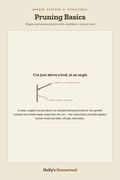
01Cut just above a bud, at an angle
A clean, angled cut just above an outward-facing bud directs new growth outward and sheds water away from the cut — the same basic principle applies across most fruit trees, shrubs, and roses.
02What you'll need
- Sharp, clean secateurs for small growth
- Loppers for thicker branches
- A pruning saw for anything loppers can't manage
- Rubbing alcohol or similar, for cleaning tools between plants if disease is a concern
03Method
- 1. Identify the goal first — shaping, renewal, disease/damage removal, or encouraging fruiting.
- 2. Remove dead, damaged, or diseased wood first, regardless of other goals.
- 3. Remove crossing or inward-growing branches to open up the centre for light and airflow.
- 4. Make angled cuts just above an outward-facing bud, sloping away from the bud so water runs off.
- 5. Step back periodically to assess the overall shape rather than making cut after cut without checking progress.
04Troubleshooting
- Plant not fruiting after pruning — some fruit trees fruit on last year's wood, others on new growth; pruning at the wrong time or removing the wrong wood can remove the coming season's fruit.
- Excessive regrowth after a hard prune — a common response to heavy pruning; expect and plan for a flush of vigorous growth that may need thinning again.
- Disease spreading through cuts — clean tools between plants, and avoid pruning susceptible species in wet weather when infection risk is higher.
- Unsure where to cut — when in doubt, make a smaller cut and reassess, rather than removing more than necessary in one go.
05Timing & maintenance
Best time
Most trees and shrubs: winter, while dormant. Stone fruit and some ornamentals: summer, to reduce disease entry risk.
Duration
From minutes for a small shrub to a full day for a mature, neglected tree.
Maintenance
Generally an annual task per plant, timed to that species' specific requirements.
Signs of success
An open, balanced shape with good light penetration, and strong new growth from the remaining buds the following season.
06Tips & variations
Pairs well with
Grafting BasicsCommon mistakes
Pruning at the wrong time of year for that specific plant, removing the coming season's fruitMaking flat cuts instead of angled ones, which pool water and invite rotPro tip
Research the specific pruning needs of each plant before cutting — timing and technique vary significantly between, say, roses, stone fruit, and pome fruit.