Holly's Homestead — Spice
Saffron
Crocus sativus · Iris family
DIFFICULTY Moderate
TYPE Perennial corm, autumn-flowering
MATURITY 6–10 weeks to flowers
TYPE Perennial corm, autumn-flowering
MATURITY 6–10 weeks to flowers
Sun
Full sun
Water
Light in autumn and winter; dry in summer
Soil pH
6.0–8.0
Spacing
10cm apart
Depth
10–15cm
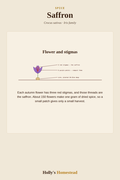
01Flower and stigmas
Each autumn flower has three red stigmas, and those threads are the saffron. About 150 flowers make one gram of dried spice, so a small patch gives only a small harvest.
02Planting
Method
Plant corms pointy end up, 10–15cm deep and 10cm apart, in very well-drained soil. Corms flower in the first autumn.
Soil
Very free-draining soil, ideally sandy or gravelly or a raised bed. It tolerates alkaline soil but not wet feet.
Timing
Plant corms in late summer to early autumn (February to March); they flower in autumn, about 6–10 weeks later.
Source
Buy Crocus sativus corms from a specialist grower, as other autumn crocuses are not saffron and some are poisonous.
Planting timing varies significantly by Australian climate zone. Set your zone above (or use the Find My Climate Zone tool) for guidance tailored to your own area.
03Growing care
- Water lightly after planting and through autumn and winter if it is dry, but keep summers dry.
- Weed carefully while leaves are growing, since corms are shallow-rooted.
- Leave the grass-like leaves to die down naturally, because they feed next year’s flowers.
- Lift and divide corms every 3–4 years in summer when dormant, and replant in fresh ground.
04Problems
- Corm rot — corms rot in wet, heavy soil, especially in summer; plant in raised beds or sandy soil.
- Rodents and rabbits — dig up and eat corms; plant in a wire cage or a raised bed with mesh below.
- Poor flowering — caused by shade, small corms, or planting too shallow; use plump corms in full sun.
- Humid summers — the corms need a hot, dry rest, and in humid regions they tend to rot rather than flower.
05Harvest & storage
Signs
Pick the flowers on the morning they open. They bloom for only a day or two, so check daily through autumn.
Method
Pick the flowers, then pull out the three red stigmas with tweezers straight away, discarding the yellow style.
Curing
Dry the stigmas on paper in a warm, dark, airy spot for a few days, or at the lowest setting of a dehydrator until brittle.
Storage
Whole threads, in an airtight jar in the dark, keep up to 2 years, though flavour fades over time.
Preserving
See Dehydrating (drying stigmas gently at low heat) for ways to keep a harvest surplus.
06Companions & rotation
Plant nearby
LavenderRosemaryThymeAvoid nearby
Wet, irrigated bedsRotation note
Lift and divide corms every 3–4 years; replant in fresh ground.