Holly's Homestead — Pest & Disease
Companion Planting Principles
Use plant relationships to support a healthier garden
DIFFICULTY Easy
TYPE Ongoing planning practice
TIME Planning time only
TYPE Ongoing planning practice
TIME Planning time only
Difficulty
Easy
Time
Planning only
Cost
Free
Best Season
At planning/planting time
Frequency
Every planting cycle
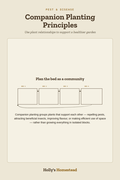
01Plan the bed as a community
Companion planting groups plants that support each other — repelling pests, attracting beneficial insects, improving flavour, or making efficient use of space — rather than growing everything in isolated blocks.
02What you'll need
- A garden plan or notebook
- Knowledge of which plants pair well (see individual crop guides for specifics)
- A mixed range of vegetables, herbs, and flowers to work with
03Method
- 1. Start with your main crops, then identify known companions for each (check individual grow guides).
- 2. Interplant beneficial pairings — e.g. basil near tomatoes, marigold as a general pest deterrent.
- 3. Avoid known antagonistic pairings (e.g. alliums near legumes).
- 4. Include flowers and herbs specifically to attract pollinators and beneficial insects, not just edible yield.
- 5. Observe and adjust each season — companion planting benefits are but often subtle, and local conditions vary.
04Troubleshooting
- No obvious benefit observed — companion planting effects are often modest and cumulative rather than dramatic; don't expect a single pairing to solve a serious pest problem.
- Overcrowding — interplanting still needs to respect each plant's actual space and light requirements.
- Conflicting information between sources — much companion planting advice is traditional/anecdotal rather than rigorously tested; treat it as a reasonable starting heuristic, not an absolute rule.
- Difficulty planning a diverse bed — start simple, with 2–3 well-documented pairings, rather than trying to optimise everything at once.
05Timing & maintenance
Best time
At the planning stage, before each planting — ideally sketched out ahead of the season.
Duration
An ongoing practice reconsidered each planting cycle rather than a one-off task.
Maintenance
Review and adjust the plan each season based on what worked and what didn't.
Signs of success
A generally more resilient, diverse bed with fewer severe pest outbreaks than a monoculture block.
06Tips & variations
Pairs well with
Crop Rotation PlanningOrganic Pest ControlCommon mistakes
Treating companion planting as a guaranteed pest solution rather than one supportive factor among manyIgnoring individual plants' actual space and light needs when interplantingPro tip
Flowers like marigold, calendula, and alyssum are a simple, low-effort way to bring beneficial insects into any vegetable bed.