Holly's Homestead — Land & Property Infrastructure
Tool Maintenance & Sharpening
Keep hand tools and blades in good working condition
DIFFICULTY Easy
TYPE Ongoing routine practice
TIME 10–20 min per tool
TYPE Ongoing routine practice
TIME 10–20 min per tool
Difficulty
Easy
Time
10–20 min/tool
Cost
Low
Best Season
Year-round
Frequency
Regularly, before and after heavy use
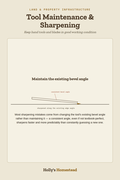
01Maintain the existing bevel angle
Most sharpening mistakes come from changing the tool's existing bevel angle rather than maintaining it — a consistent angle, even if not textbook-perfect, sharpens faster and more predictably than constantly guessing a new one.
02What you'll need
- A sharpening stone or file appropriate to the tool
- A honing guide (optional, helps maintain a consistent angle)
- Oil or water for stone lubrication, per stone type
- A wire brush and oil for general tool cleaning and rust prevention
03Method
- 1. Clean the tool of dirt, sap, or rust before sharpening.
- 2. Identify the existing bevel angle and maintain it consistently through the sharpening process.
- 3. Sharpen using smooth, consistent strokes, working from coarser to finer grit as needed.
- 4. Remove the resulting burr with a fine stone or strop.
- 5. Oil metal parts before storage to prevent rust, particularly for tools not used for a while.
04Troubleshooting
- Blade won't take a sharp edge — check for a consistent angle throughout the stroke; a wandering angle prevents a clean edge from forming.
- Tool rusting between uses — clean and lightly oil after each use, and store in a dry location.
- Sharpening making the edge worse — usually inconsistent angle or too aggressive a grit for touch-up maintenance; use finer grits for routine maintenance, coarser only for damage or reshaping.
- Handle or fitting becoming loose — address promptly; a loose handle is a safety issue as much as a maintenance one.
05Timing & maintenance
Best time
Before heavy seasonal use (start of pruning season, for example), and periodically through the year.
Duration
10–20 minutes per tool for routine maintenance sharpening.
Maintenance
Regular light maintenance is far more effective than occasional heavy correction — little and often.
Signs of success
Tools that cut cleanly with reasonable effort, hold an edge through normal use, and show no active rust.
06Tips & variations
Pairs well with
Pruning BasicsButchering Lamb & GoatCommon mistakes
Trying to establish a completely new bevel angle instead of maintaining the existing oneNeglecting tools between uses, allowing rust and dulling to compoundPro tip
A few minutes of touch-up sharpening before each use session prevents the far longer, more difficult job of restoring a badly neglected edge.