Holly's Homestead — Alternative Energy
Wind Power Basics
Small-scale turbines for a supplementary power source
DIFFICULTY Hard
TYPE One-off installation, ongoing generation
TIME Weeks of assessment, days to install
TYPE One-off installation, ongoing generation
TIME Weeks of assessment, days to install
Difficulty
Hard
Time
Assessment + install
Cost
Moderate–high
Best Season
Assess wind across seasons first
Frequency
Variable, weather-dependent
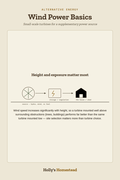
01Height and exposure matter most
Wind speed increases significantly with height, so a turbine mounted well above surrounding obstructions (trees, buildings) performs far better than the same turbine mounted low — site selection matters more than turbine choice.
02What you'll need
- A site assessment showing consistent average wind speed
- A turbine sized to realistic local conditions (small-scale turbines suit supplementary power, not full self-sufficiency)
- A sturdy tower well clear of turbulence from nearby obstructions
- A charge controller and battery bank
03Method
- 1. Assess average wind speed at the proposed site across as many seasons as possible — a log or simple anemometer reading over months gives a realistic picture.
- 2. Choose a site clear of turbulence from trees, buildings, and terrain features.
- 3. Select a turbine and tower height appropriate to realistic (not best-case) wind conditions.
- 4. Install the tower and turbine per manufacturer specifications, with appropriate guying or footing for the site's wind loads.
- 5. Connect to a charge controller and battery bank, and commission the system.
04Troubleshooting
- Output much lower than expected — most commonly, insufficient average wind speed or a site too affected by turbulence; reassess site selection.
- Excessive noise or vibration — often a sign of an undersized tower or poor mounting; review installation against manufacturer specs.
- Turbine damage in storms — check the turbine has an appropriate over-speed/furling protection mechanism for extreme wind events.
- Inconsistent output — inherent to wind power; pair with battery storage and another generation source for reliability.
05Timing & maintenance
Best time
Assess wind conditions across a full year before committing to turbine size and tower height.
Duration
Output varies continuously with wind conditions rather than being predictable day to day.
Maintenance
Periodic inspection of blades, tower, and connections, particularly after severe weather.
Signs of success
Output broadly tracking measured wind conditions, without unexpected shutdowns or damage in normal weather.
06Tips & variations
Pairs well with
Backup GeneratorsMicro-Hydro Power BasicsCommon mistakes
Mounting the turbine too low or too close to turbulence-causing obstructionsRelying on manufacturer best-case output figures rather than your own site's realistic average wind speedPro tip
Small-scale wind rarely makes sense as a sole power source in most of Australia — it's usually best considered a supplementary source alongside solar, sized modestly.