Holly's Homestead — Alternative Energy
Backup Generators
Reliable power for outages and heavy short-term loads
DIFFICULTY Easy–moderate
TYPE One-off purchase/setup, ongoing maintenance
TIME A few hours to set up
TYPE One-off purchase/setup, ongoing maintenance
TIME A few hours to set up
Difficulty
Easy–moderate
Time
Setup: a few hours
Cost
Moderate
Best Season
Any time
Frequency
Run periodically, used during outages
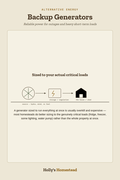
01Sized to your actual critical loads
A generator sized to run everything at once is usually overkill and expensive — most homesteads do better sizing to the critical loads (fridge, freezer, some lighting, water pump) rather than the whole property at once.
02What you'll need
- A generator sized to your critical load list, with some margin
- Appropriate fuel storage (petrol, diesel, or LPG depending on generator type)
- A transfer switch if connecting to household wiring (essential for safety)
- Regular maintenance supplies (oil, filters, spark plugs as applicable)
03Method
- 1. List your critical loads and their combined running (not just starting) wattage.
- 2. Choose a generator sized with reasonable margin above that critical load total.
- 3. Install a proper transfer switch if connecting to household circuits — never back-feed through a wall socket, which is dangerous to utility workers and illegal.
- 4. Store fuel safely and rotate stock so it doesn't degrade.
- 5. Run and test the generator periodically, not just when an outage occurs — a generator that hasn't run in months may fail exactly when needed.
04Troubleshooting
- Won't start after sitting unused — stale fuel is the most common cause; use a fuel stabiliser or rotate fuel stock, and run the generator periodically.
- Overloaded and tripping — recalculate actual running wattage of connected loads, including motor starting surge for things like fridges and pumps.
- Unsafe back-feeding into household wiring — always use a proper transfer switch, never a workaround; this is a safety hazard.
- Excessive fuel use — running a large generator for a small load is inefficient; match generator size to actual need, or consider a smaller unit for baseline loads.
05Timing & maintenance
Best time
Set up and test before you need it, ideally right after purchase, not during your first outage.
Duration
Modern generators can run continuously for many hours per fuel tank, refuelled as needed.
Maintenance
Regular test runs, oil changes per manufacturer schedule, and fuel stock rotation.
Signs of success
Starts reliably on the first or second pull/attempt, and runs your critical loads without tripping or overloading.
06Tips & variations
Pairs well with
Micro-Hydro Power BasicsWind Power BasicsCommon mistakes
Back-feeding a generator into household wiring without a transfer switchLetting the generator sit unused for months without a test runPro tip
A quarterly test run under an actual load (not just idling) is the single best way to know your generator will work when you actually need it.